Electrical Requirements for a Home Sauna: 120V vs 240V, Amps & Wiring
Home sauna electrical requirements, from voltage and amperage to heater power, dedicated circuits and panel capacity before installation.
What Electrical Requirements Does a Home Sauna Need?
Buying a home sauna can quickly introduce electrical questions that most homeowners have never had to think about.
You may find one sauna that plugs into a standard 120V outlet, another that requires a dedicated circuit, and a traditional sauna heater that needs a 240V hardwired connection installed by an electrician. Product specifications may list volts, amps and kilowatts without making it immediately clear what any of that means for your home—or how much work may be required before the sauna can be used.
That makes the electrical setup an important part of choosing a sauna, not something to figure out after it arrives.
The basic distinction is relatively simple. Compact infrared saunas are the most likely to operate on 120V power, while traditional electric sauna heaters commonly use 240V and are often hardwired. Larger infrared and hybrid systems can also require 240V power, however, so the sauna type alone does not determine the electrical connection.
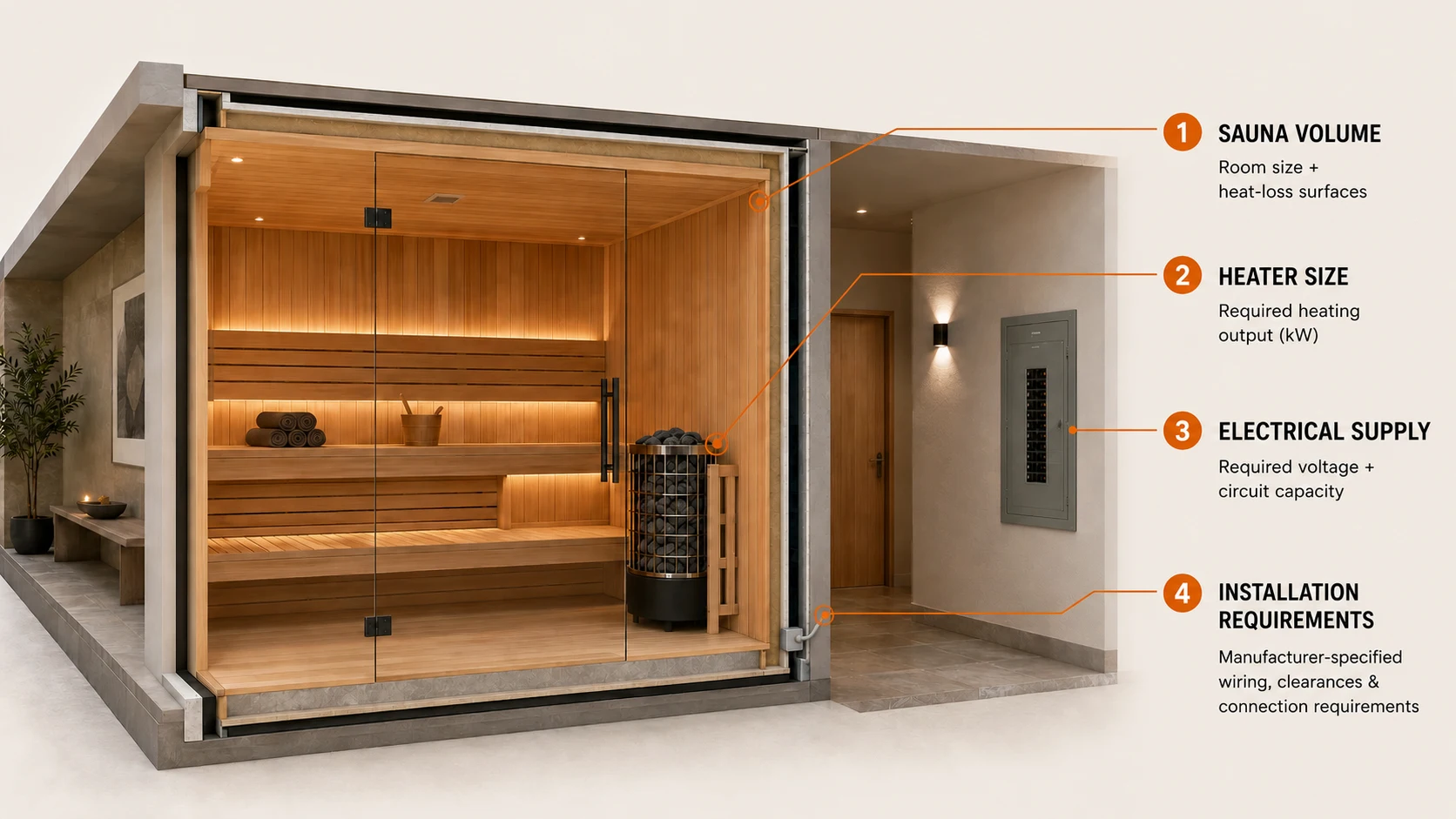
Before buying, you need to know five things: the required voltage, system or heater power in kilowatts, rated amperage, required circuit and whether the unit is plug-in or hardwired. Together, these specifications help determine whether your existing electrical system can support the sauna or whether additional electrical work may be necessary.
You do not need to become an electrician to make sense of these requirements. This guide explains what 120V and 240V mean for a home sauna, how amps and heater power relate to the circuit, when a dedicated circuit is typically involved, and what to check before purchasing.
There is no universal breaker size, wire size or connection method for every home sauna. The final installation must follow the specifications for the exact sauna or heater, applicable local electrical code and the requirements confirmed by a licensed electrician.
120V vs 240V Sauna: What’s the Difference?
The voltage requirement is one of the first electrical specifications to check, but it needs to be read together with heater power, amperage, circuit requirements and the way the sauna connects to the home.
120V sauna systems
120V power is most common in compact infrared cabins and other lower-power sauna systems. Some models use a factory-installed cord and connect to a compatible grounded receptacle, which can make the physical installation simpler than a traditional electric sauna heater.
That does not mean every 120V sauna can be plugged into any existing household outlet. The model may require a dedicated 15A or 20A circuit, and higher-output 120V systems can have different receptacle and circuit requirements. The sauna’s electrical specification should be checked before assuming the existing outlet is suitable.
240V sauna systems
240V is common for traditional electric sauna heaters because it supports the higher heater outputs typically required for larger rooms and higher-temperature sauna operation. Residential traditional heaters are frequently hardwired on a dedicated circuit, with the exact electrical requirements determined by the heater model.
Some larger infrared and hybrid saunas also operate on 240V. These are not necessarily hardwired: certain models use a dedicated 240V receptacle instead. For that reason, 240V should not be treated as another word for hardwired.
Voltage does not tell you the whole electrical requirement
Two saunas that both use 240V can place very different loads on the electrical system. A 4.5 kW traditional heater and a 9 kW heater use the same nominal voltage but draw different current and can require different circuit configurations.
The same principle applies to 120V systems. Voltage identifies the supply, while heater or system power and rated amperage help determine the actual electrical load. This is why the complete manufacturer specification matters more than the voltage number by itself.
In our 2026 U.S. home sauna market analysis, 43 of 80 models eligible for a standardized 120V/240V comparison used 120V (53.75%), while 37 used 240V (46.25%). Two additional included models had verified 220V listings and were excluded from that two-voltage comparison.
| Voltage | Typical sauna type | Installation | Power capability | What to check |
|---|---|---|---|---|
| 120V | Compact infrared and some lower-power systems | Often cord-and-plug, but the required receptacle and dedicated circuit depend on the model | Generally suited to lower electrical loads and smaller sauna systems | Rated amperage, dedicated-circuit requirement, plug and receptacle type |
| 240V | Traditional electric heaters, larger infrared and hybrid systems | Traditional heaters are commonly hardwired; some infrared systems use a dedicated 240V receptacle | Supports higher-output heaters and larger electrical loads | Heater kW, rated amperage, breaker/circuit specification, connection method and panel capacity |
These are general planning patterns, not universal installation specifications. Always use the electrical requirements for the exact sauna or heater model and have the final installation confirmed for the property and local code.
How Many Amps Does a Sauna Use?
Sauna amperage depends primarily on the electrical power of the heater or complete sauna system and the voltage it is designed to use.
For a simple single-phase load, current can be estimated by dividing watts by volts. That relationship helps explain why heater output matters: as kilowatt capacity increases at the same voltage, the current draw also increases.
Amps ≈ Watts ÷ Volts. A 6 kW heater is 6,000 watts, so 6,000 ÷ 240 gives an illustrative current draw of about 25 amps.
These calculations illustrate the relationship between heater power, voltage and current. They are not breaker-sizing or wiring instructions. Use the electrical specifications and installation manual for the exact sauna or heater.
The heater also needs to be correctly matched to the sauna room. An undersized heater may struggle to bring the room to temperature, while moving to a higher-output heater can change the electrical load that the home needs to support. If you are still determining heater capacity, use the Sauna Heater Size Calculator to estimate the heater size appropriate for the room before comparing electrical requirements.
Do not use the simple watts-divided-by-volts calculation to choose a breaker, wire gauge or other installation hardware. Manufacturer requirements can account for factors beyond the basic arithmetic, and the final circuit should be specified for the exact equipment and installation.
Sauna Heater kW and Electrical Requirements
Heater output is one of the main factors that determines the electrical load of a traditional sauna. As heater capacity increases, current draw generally increases as well.
Residential electric sauna heaters are available across a wide range of outputs. Smaller rooms may use heaters around 4.5 kW, while 6 kW and 8 kW units are common steps upward as room volume increases. Larger residential saunas can move into 9 kW, 10.5 kW or higher-output equipment.
The important point is that heater size should be chosen for the sauna room first, not reduced simply to fit an existing electrical circuit. Room volume, insulation and heat-loss surfaces such as glass can affect the heater capacity required to heat the sauna properly.
| Heater output | Example voltage | Approx. current | Planning implication |
|---|---|---|---|
| 4.5 kW | 240V | ≈18.8A | Lower-output residential heater; exact circuit requirement still depends on the manufacturer specification. |
| 6 kW | 240V | ≈25A | Common residential heater size; manufacturer examples can require a dedicated hardwired circuit. |
| 8 kW | 240V | ≈33.3A | Higher electrical load than a 6 kW heater and potentially different circuit requirements. |
| 9 kW | 240V | ≈37.5A | Often used where greater heating capacity is required; panel capacity becomes increasingly important to confirm. |
| 10.5 kW+ | Varies by heater | Model-specific | Larger residential or specialty systems require close review of the exact heater electrical specification. |
Current figures shown for 4.5–9 kW are simple 240V single-phase planning calculations using watts ÷ volts. They are not breaker sizes, conductor sizes or installation instructions. Exact requirements vary by heater and installation.
A useful buying sequence is therefore: determine the sauna room volume, identify the heater output suitable for that room, and only then confirm the voltage, amperage, circuit and panel requirements for the selected heater. This avoids choosing the electrical installation around a heater that is too small for the sauna.
Does a Home Sauna Need a Dedicated Circuit?
Many home saunas require a dedicated electrical circuit, but the exact requirement depends on the sauna or heater model rather than on the word “sauna” alone.
A dedicated circuit supplies the sauna equipment without sharing that branch circuit with unrelated household loads. This is common with traditional electric sauna heaters and with many infrared systems whose manufacturer specifies a dedicated 120V or 240V circuit.
The reason is straightforward: sauna heaters can represent a substantial and predictable electrical load. Sharing the same circuit with lighting, receptacles or other appliances can conflict with the equipment requirements and may create nuisance tripping or an installation that does not match the manufacturer’s instructions.
For traditional electric saunas, the heater is commonly connected to its own 240V circuit and is often hardwired. Compact infrared cabins may use a cord-and-plug connection, but some still require a dedicated 15A or 20A circuit even though they plug into a receptacle. Plug-in does not automatically mean shared circuit.
The correct approach is to check the electrical data for the exact model before installation. Look for the specified voltage, rated current, required circuit, connection method and any separate electrical requirements for controls, lighting or accessories.
Do not assume that an existing nearby outlet or spare breaker is suitable simply because the voltage appears to match. The final circuit arrangement should follow the manufacturer’s installation instructions and applicable local electrical code, with the home’s existing electrical capacity verified before the sauna is connected.
Plug-In vs Hardwired Saunas
The way a sauna connects to the home electrical system is separate from its voltage. A sauna can be 120V or 240V and still use a connection method that is specific to that model.
Plug-in sauna systems
Plug-in connections are most common with compact infrared saunas and other lower-power systems supplied with a factory-installed cord. These models connect to the receptacle type specified by the manufacturer rather than being permanently wired into the home.
A plug-in design can simplify installation, but it does not mean that any nearby household outlet is suitable. Some models still require a dedicated circuit, and the required voltage, amperage and receptacle must match the sauna specification. The differences between infrared and traditional systems are covered in more detail in our Infrared Sauna vs Traditional Sauna comparison.
Hardwired sauna systems
Hardwired connections are common with traditional electric sauna heaters. In this arrangement, the heater is permanently connected to the electrical supply rather than using a removable plug, and the installation should follow the exact heater manual and local electrical requirements.
Manufacturer specifications also show why voltage and connection type should not be collapsed into one assumption. The Harvia KIP Series Electric Sauna Heater, for example, includes residential 240V heater options, while the exact electrical requirements depend on the selected output and installation. Always use the specifications and installation documentation for the exact heater model.
Do not change the connection method to simplify installation
If a sauna is supplied as hardwired equipment, it should not be converted to a plug-in connection simply to avoid electrical work. Likewise, a factory cord-and-plug sauna should be connected using the receptacle and circuit specified for that system rather than adapted around whatever outlet happens to be available.
Before ordering, confirm both the electrical supply and the connection method. Two saunas with the same nominal voltage can require very different installation work, which can affect electrician time, panel planning and the total cost of getting the sauna operational.
Electrical Requirements for Infrared vs Traditional Saunas
Infrared and traditional electric saunas can place very different demands on a home electrical system, but sauna type alone is not enough to determine the final installation.
Infrared sauna electrical requirements
Compact infrared cabins are among the easiest home saunas to accommodate electrically. Many smaller models operate on 120V power and use a factory-installed plug, although the manufacturer may still specify a dedicated 15A or 20A circuit.
Electrical requirements increase as infrared cabins become larger or add more heating elements and features. Some larger infrared and full-spectrum systems use 240V power, so buyers should not assume that every infrared sauna is a standard-outlet appliance.
Controls, lighting, red-light panels and other integrated features can also affect the complete electrical specification. Check the requirements for the entire sauna system rather than looking only at the infrared heater technology.
Traditional electric sauna requirements
Traditional electric saunas generally use a higher-output heater to warm the room air and sauna stones. In North American residential installations, 240V operation is common, and the heater is typically planned around a dedicated circuit and model-specific electrical requirements.
Why the distinction matters before you buy
A smaller plug-in infrared sauna may require little electrical work if the correct circuit is already available. A traditional electric sauna can involve a dedicated 240V circuit, hardwired heater connection and a closer review of available panel capacity. Larger infrared and hybrid systems can fall somewhere between those two patterns.
That difference can affect installation cost and whether electrical work needs to be completed before the sauna arrives. The safest planning approach is to compare the exact voltage, rated amperage, circuit and connection requirements of the models you are considering rather than choosing by sauna type alone.
Indoor vs Outdoor Sauna Electrical Requirements
An indoor and outdoor sauna can use the same heater and have similar basic power requirements, but an outdoor installation usually adds another layer of electrical planning between the home and the sauna location.
Indoor sauna electrical planning
For an indoor sauna, the main questions are usually whether the home has the required voltage, enough panel capacity and a suitable route for the dedicated circuit or receptacle specified by the sauna manufacturer.
The distance from the electrical panel, the location of the heater and controls, and any separate requirements for lighting or accessories can affect the installation scope. A nearby electrical panel can make the project simpler, but proximity alone does not determine whether the existing electrical system is suitable.
Outdoor sauna electrical planning
Outdoor saunas add exposure, distance and routing considerations. Power may need to travel from the house to a detached sauna, and the electrician has to account for the outdoor environment, the route of the circuit and any weather-resistant or location-specific equipment required by the manufacturer and local code.
This is one reason electrical planning should happen while deciding between an indoor and outdoor installation, rather than after the sauna has been ordered. Our Indoor vs Outdoor Sauna guide covers the broader differences in placement, installation, maintenance and homeowner fit. Ventilation should be planned at the same stage because intake, exhaust and airflow can also depend on the sauna layout and installation method. Our Sauna Ventilation Requirements guide covers that part of the project in detail.
Manufacturer requirements remain model-specific. For example, Harvia’s installation documentation states that electrical connections must be completed in accordance with current regulations by an authorised, licensed professional electrician and directs installers to the wiring diagram for the exact heater and control system. Harvia’s Virta installation manual is one example of that model-specific approach.
The heater load may be similar, but the installation scope may not be
Moving a sauna outdoors does not automatically change the electrical load of a given heater. What can change is the work required to deliver power safely to the sauna location and install the associated controls and equipment in an appropriate environment.
That can make an outdoor electrical installation more involved even when the heater itself has the same nominal voltage and output as an indoor installation. Before buying, give the electrician the exact sauna location, heater model, electrical specification and approximate distance from the home’s electrical panel so the complete installation can be assessed.
Does Your Electrical Panel Have Enough Capacity?
Adding a sauna is not only a question of finding an unused breaker position. The home’s electrical system also needs enough capacity to support the additional sauna load alongside the other electrical demands already placed on the service.
Breaker space and electrical capacity are not the same thing
An electrical panel may have an open breaker position without necessarily having enough available service capacity for a new sauna circuit. A higher-output electric sauna heater can add a meaningful load, particularly in homes that already have electric HVAC, water heating, cooking equipment, EV charging or other large electrical loads.
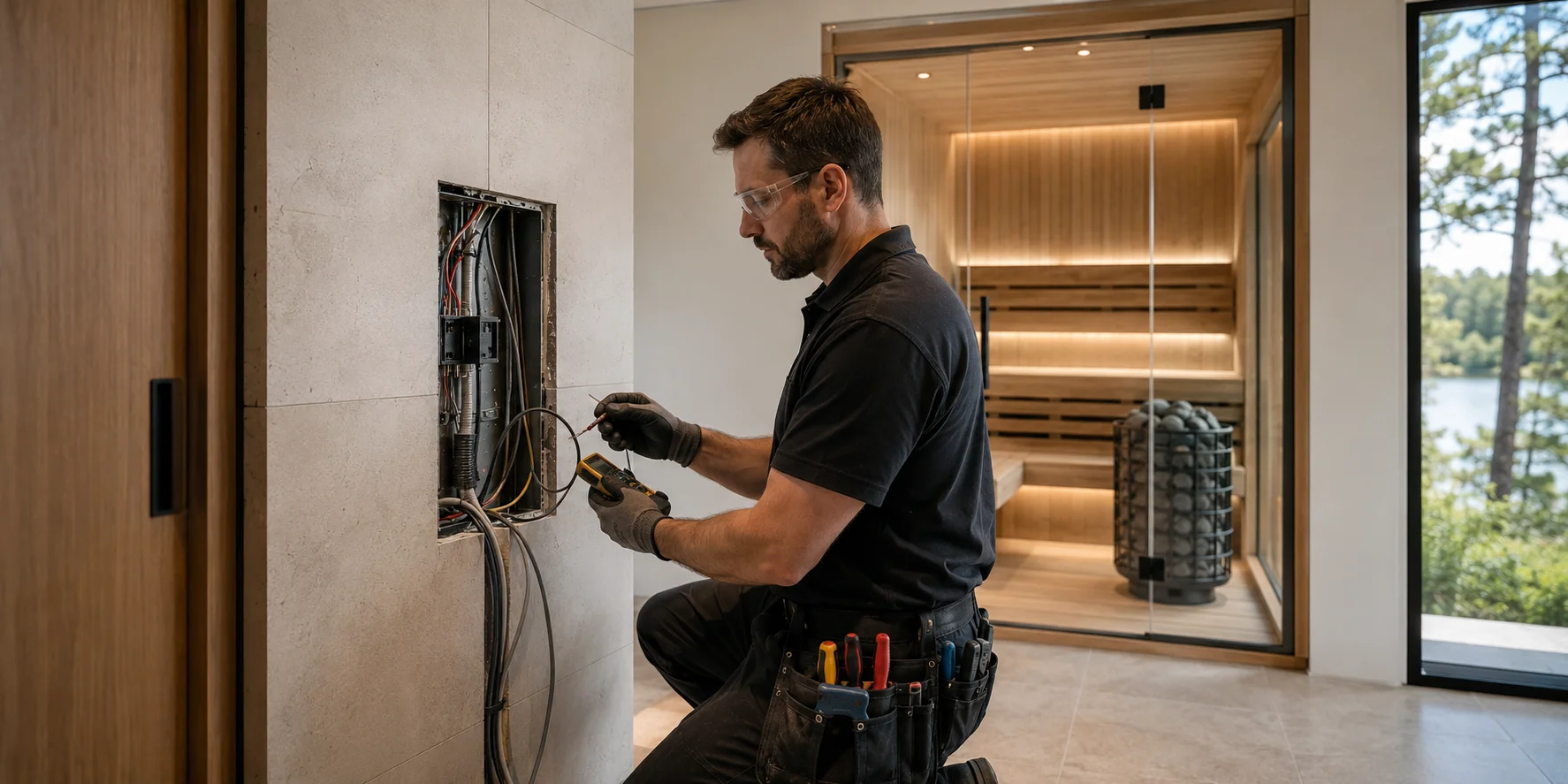
For that reason, available breaker space is only one part of the assessment. The electrician may also need to consider the home’s electrical service, existing loads and the requirements of the specific sauna or heater being installed.
When a panel or service upgrade may be necessary
If the existing electrical system cannot comfortably accommodate the additional load, the project may require more than simply adding a sauna circuit. Depending on the property, possible solutions can include changes to the panel, additional distribution equipment or an electrical service upgrade.
That does not mean a panel upgrade is automatically required for a 240V sauna. Two homes installing the same heater can have very different electrical situations because their existing service capacity and household loads are different.
This is also why electrical work can become an important part of the overall project budget. If you are estimating the complete installation rather than only the sauna purchase price, our home sauna cost guide explains the other costs that can accompany the equipment itself.
Have the electrical capacity checked before ordering
For a higher-output traditional sauna in particular, it is worth confirming the electrical situation before committing to the final heater. Give the electrician the heater’s voltage, rated power, amperage and manufacturer electrical requirements so the proposed sauna load can be considered together with the rest of the home.
This check is especially useful when the sauna is part of a larger home wellness project that may eventually include other substantial electrical loads.
GFCI, Disconnects and Local Electrical Code
Electrical safety requirements around a sauna depend on more than voltage and amperage. The exact installation can also be affected by the sauna location, the heater or control system, the type of connection and the electrical code adopted where the home is located.
Do not assume every sauna has the same GFCI requirement
GFCI requirements can vary by equipment and installation. Outdoor locations, nearby receptacles and other parts of the electrical installation may be subject to requirements that differ from those for the heater itself.
This is also an area where the manufacturer’s installation manual matters. Some sauna-heater documentation contains specific instructions about ground-fault protection that should not be replaced with a general rule applied to every sauna. For example, Harvia’s Virta installation manual directs the electrician to follow the model-specific electrical requirements and applicable regulations.
Disconnect requirements can also be installation-specific
A local electrical code or the equipment specification may require a means of disconnecting power for servicing or safety. Where it must be located and how it must be configured can depend on the installation and the rules enforced by the local authority.
For planning purposes, the important point is not to decide on a disconnect arrangement before the exact sauna equipment and installation location are known.
What should be confirmed before installation
Before electrical work begins, the electrician should have enough information to confirm:
- the exact sauna or heater model;
- whether the installation is indoor or outdoor;
- the manufacturer’s wiring and protection requirements;
- the location of controls, power units and other electrical components;
- the electrical code and local amendments that apply to the property.
The manufacturer manual and local authority have the final say
For a homeowner, the safest planning approach is simple: use the electrical specifications for the exact sauna or heater, then have a licensed electrician confirm how those requirements interact with the local electrical code.
That prevents a common mistake in sauna planning: taking a breaker, GFCI or disconnect requirement from another heater and assuming it applies to the one being installed.
How Electrical Requirements Affect Sauna Operating Cost
The electrical specification tells you how much power a sauna can draw, but it does not by itself tell you what every sauna session will cost.
A higher-output heater can use more electricity while it is actively heating, but actual energy consumption also depends on warm-up time, session length, thermostat cycling, sauna-room insulation, temperature setting and how well the heater is matched to the space.
Once the sauna reaches its target temperature, an electric heater does not necessarily remain at full rated output continuously. The thermostat cycles the heating elements as needed to maintain temperature, which is why simply multiplying the heater’s maximum kW rating by the entire session time can overstate real-world consumption.
For a more useful estimate, enter the heater power, session duration, usage frequency and local electricity price into our Sauna Operating Cost Calculator. It can help translate the electrical specification into an estimated session, monthly and annual running cost.
Questions to Ask Your Electrician
A short conversation with an electrician before ordering can uncover electrical work that would otherwise appear only after the sauna arrives.
Bring the electrical specifications or installation manual for the exact sauna or heater and ask:
- Can my existing electrical service support this sauna? Ask for the proposed sauna load to be considered alongside the major electrical loads already serving the home.
- Does my panel have the capacity and space for the required circuit? An unused breaker position does not by itself confirm that the service has sufficient available capacity.
- What circuit and breaker will this exact model require? The answer should come from the manufacturer specifications and the requirements that apply to the installation.
- Will the sauna be hardwired or connected through a receptacle? Confirm the permitted connection method before planning the final electrical location.
- Are GFCI protection or a disconnect required for this installation? Requirements can depend on the equipment, location and locally adopted electrical code.
- Will the installation require a panel or service upgrade? If additional electrical work is needed, identify it before treating the sauna purchase price as the complete project cost.
- Are permits or inspections required? Confirm the local process and whether those costs are included in the electrician’s quote.
- What electrical work is included in the quote? Ask whether the price includes materials, circuit installation, controls, disconnects, permits, testing and any work outside the immediate sauna area.
Getting these answers in writing makes it easier to compare the electrical scope with the sauna seller’s installation requirements and reduces the chance of discovering an unbudgeted electrical upgrade later.
Conclusion
The electrical requirements for a home sauna should be confirmed before the sauna is ordered, not after installation begins. Voltage is only the starting point: heater output, rated amperage, circuit requirements, connection method, panel capacity and the installation location can all affect the electrical scope.
For the final installation, use the specifications and installation manual for the exact sauna or heater and have the electrical requirements confirmed for the property and applicable local code. This is especially important when a project may require a new dedicated circuit, a longer electrical run or an upgrade to the existing panel or service.
Once the electrical scope is clear, it should also be included in the total project budget. Use our Sauna Project Cost & Quote Analyzer to estimate the broader installed cost of the project or review a contractor or seller quote for costs that may not be included in the sauna’s purchase price.
Home sauna electrical questions
Can a home sauna run on 120V?
Yes. Some smaller sauna systems, particularly compact infrared models, are designed for 120V power. That does not mean every 120V sauna can simply be connected to any available household outlet. Check the exact model’s voltage, amperage, circuit and receptacle requirements before installation.
Do home saunas need 240V?
Many traditional electric sauna heaters use 240V in North American residential installations, especially as heater output increases. Smaller systems may use 120V, so the correct voltage should always come from the specifications for the exact sauna or heater rather than from the sauna category alone.
How many amps does a home sauna use?
Amperage varies with voltage and power. For basic planning, electrical power can be related using P = V × I, but a calculated current should not be treated as the final breaker size or wiring specification. Use the manufacturer’s electrical requirements and have the circuit confirmed for the installation.
Does a home sauna need a dedicated circuit?
Many electric sauna heaters and sauna systems require a dedicated circuit, but the exact requirement is model-specific. Confirm the manufacturer’s installation instructions before ordering so the required circuit can be planned in advance.
Does a sauna heater need GFCI protection?
There is no useful universal answer for every sauna heater and installation. Requirements can depend on the equipment, installation location and locally adopted electrical code, and manufacturer instructions may contain model-specific requirements. The exact installation should therefore be checked against both the product documentation and applicable local requirements.
Can I plug a sauna into a regular outlet?
Only when the sauna is specifically designed for that type of connection and the required circuit and receptacle are suitable for the model. Larger traditional electric heaters are commonly hardwired rather than connected to a standard household receptacle.
Do I need to upgrade my electrical panel for a sauna?
Not necessarily. An electrician should consider the sauna load together with the home’s existing electrical loads and service capacity. An open breaker position alone does not establish that the electrical service has enough available capacity for the new circuit.
Should a sauna heater be hardwired?
Many traditional electric sauna heaters are designed for permanent electrical connections, while some compact sauna systems use cord-and-plug connections. Follow the connection method specified for the exact model rather than choosing between plug-in and hardwired installation based on convenience.
Sources & methodology
Verdict Lux reviewed North American sauna-heater installation manuals, infrared-sauna electrical requirements, outdoor-sauna electrical documentation and independent U.S. residential-panel research to check this guide’s voltage, amperage, wiring and service-capacity claims. Manufacturer tables were used for model-specific electrical examples, while breaker, conductor, GFCI and disconnect guidance was kept model- and jurisdiction-specific rather than generalized. This is a research-based planning guide, not electrical installation instructions.
We cross-checked published requirements for 120V and 240V infrared systems, 240V traditional electric heaters and an outdoor sauna installation. Simple watts ÷ volts calculations were used only to explain current draw, then checked against manufacturer amperage tables where matching heater outputs were available; they were not used to prescribe breaker or conductor size. We also checked independent research on residential panel capacity and available breaker space. Verdict Lux did not perform hands-on electrical testing or installation work for this guide.
Electrical requirements can change by exact sauna or heater model, control system, installation location and the code adopted where the property is located. Before purchasing or installing equipment, use the current documentation for the exact model and have a licensed electrician confirm circuit protection, conductor sizing, grounding, GFCI or disconnect requirements and applicable local amendments.