Infrared Sauna vs Traditional Sauna: Which Is Better?
Infrared and traditional saunas deliver heat in very different ways. We compare temperature, experience, installation, running costs and research to help you choose the right sauna for your home.
Infrared or traditional sauna?
If you are choosing between an infrared and a traditional sauna, the biggest difference is not simply how hot each one gets. They create two noticeably different sauna experiences. Infrared uses radiant heat and keeps the room temperature lower, while a traditional sauna heats the air and sauna stones to create the hotter, classic environment many people associate with sauna. That difference affects how the heat feels, how long the sauna takes to warm up, what it needs from your electrical system, how involved installation can be and what it may cost to run. The better choice is the one that matches the kind of sessions you will actually enjoy and the installation your home can support.
Convenience matters more than traditional heat
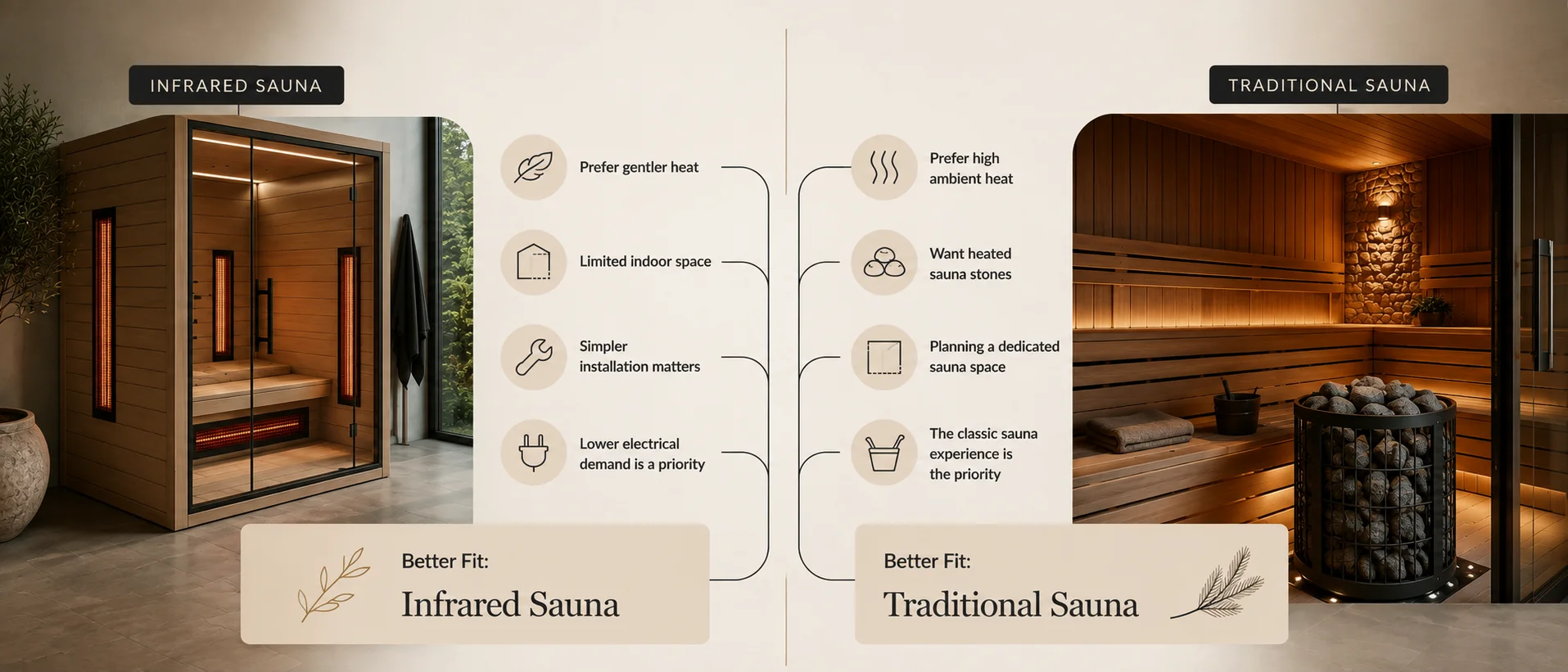
- You prefer lower-temperature sauna sessions.
- You want a compact indoor cabin and relatively simple setup.
- Lower electrical demand and running cost matter to you.
- Sauna stones and steam are not essential to your experience.
The sauna experience itself is the priority
- You want higher air temperatures and a classic sauna feel.
- You want heated stones and the option to add water for steam.
- You are prepared to plan around the sauna heater and its requirements.
- You want a dedicated sauna room or a larger, more flexible installation.
Infrared vs traditional sauna: key differences
Use this as the quick comparison. The sections that follow focus on the differences that materially affect buying and owning a sauna at home.
| Feature | Infrared sauna | Traditional sauna |
|---|---|---|
| Heating method | Infrared emitters provide radiant heat. | A heater warms the room and sauna stones. |
| Air temperature | Typically lower. | Typically higher. |
| Heat feel | Gentler ambient heat with direct radiant warmth. | Hotter room-wide heat with the option to add water to the stones. |
| Warm-up | Often quicker to become usable. | Usually takes longer to heat the room and stones. |
| Installation | Often simpler, especially for compact indoor cabins. | Usually requires more planning around the heater, ventilation and clearances. |
| Electrical demand | Generally lower for small residential cabins. | Often higher with electric sauna heaters. |
| Running cost | Often lower, depending on power and session length. | Often higher, especially with larger heaters and longer preheating. |
| Best for | Convenience, gentler heat and compact home installations. | High heat, heated stones and the classic sauna experience. |
Two ways to create a sauna session
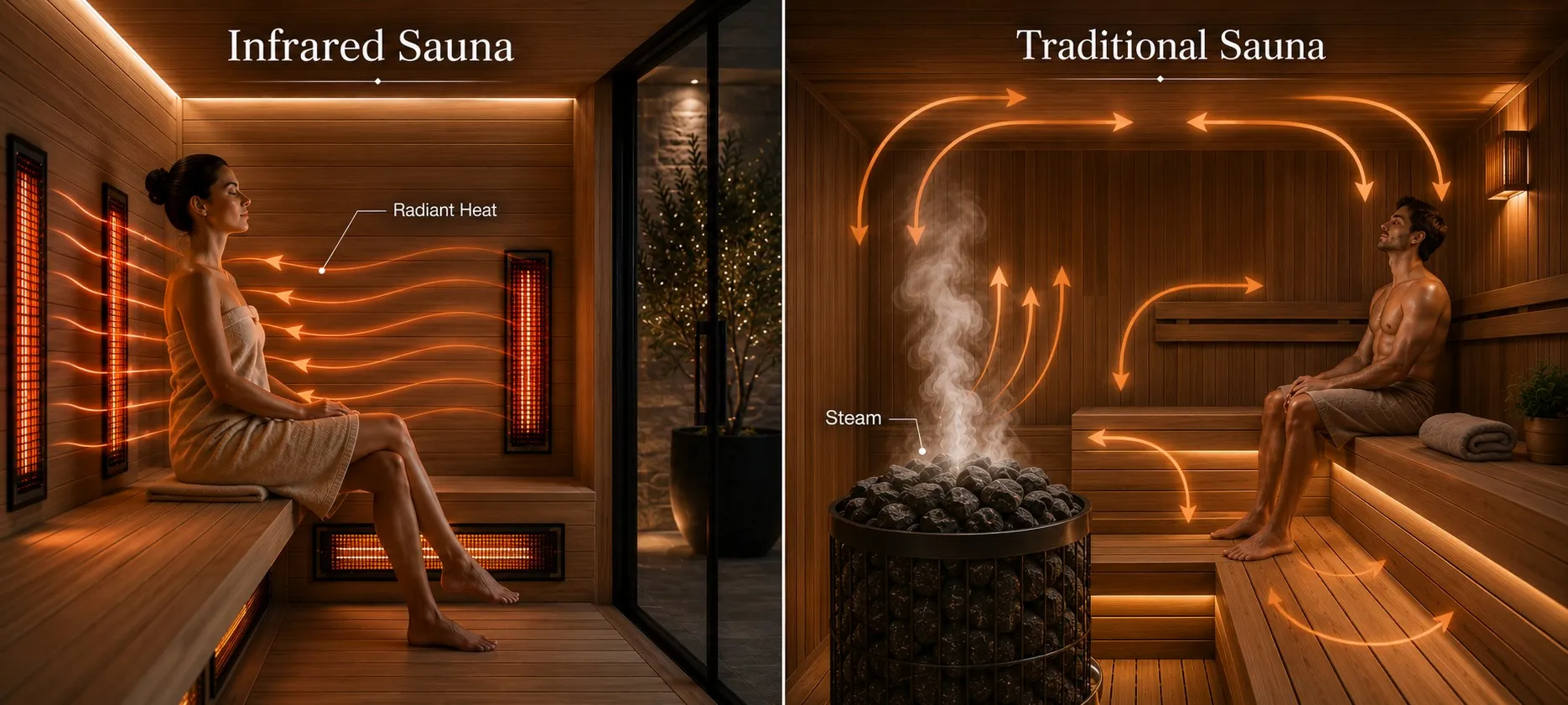
These systems feel different because they heat the sauna differently. Infrared emitters direct radiant energy toward the user while the surrounding air stays comparatively cooler. A traditional heater warms the room and a mass of sauna stones, producing the hotter ambient conditions most people associate with a classic sauna.
In practice, infrared lets you sit in a cooler room while still receiving strong radiant warmth. Traditional surrounds you with hotter air and adds the tactile element of heated stones. Pouring water over those stones creates the brief burst of steam known in Finnish sauna culture as löyly.
How hot does each sauna get?
The temperature gap is one of the clearest differences you will notice in use. Infrared saunas typically operate at substantially lower air temperatures, while traditional saunas are designed around a much hotter room.
The lower air temperature generally feels easier to tolerate for people who dislike an intensely hot room. The experience is still distinctly warm, but the cabin does not need to reach traditional-sauna temperatures.
Traditional sauna surrounds you with much hotter ambient air. That higher room temperature is a defining part of the experience and creates a more intense sensation of heat than the thermometer range of a typical infrared cabin.
Installation: infrared is usually easier
Installation can decide the purchase before heat preference does. A compact infrared cabin may fit into an existing indoor room with relatively little modification. A traditional electric sauna usually asks for more coordination between room volume, heater sizing and the electrical supply.
Infrared sauna installation
Infrared cabins are commonly sold as self-contained units, which can make them easier to add to a bedroom, home gym, basement or other suitable indoor space. Smaller models may operate on 120V power, while larger cabins can require 240V. The voltage, amperage and dedicated-circuit requirements depend on the specific model, so “plug-in” should never be assumed from the infrared label alone.
The practical advantage is that you are usually installing a finished cabin rather than designing a hot room around a separate sauna heater. You still need to confirm floor space, access for delivery and assembly, required clearances and the manufacturer’s electrical specifications before ordering.
Traditional sauna installation
A traditional electric sauna involves more planning because the heater has to be appropriate for the room it is expected to heat. In North American residential installations, electric sauna heaters commonly use 240V power and are often hardwired on a dedicated circuit. The required breaker, wire size and installation method depend on the heater rather than on a universal sauna specification.
Room volume also matters. Ceiling height, insulation and areas of glass, masonry or other non-insulated surfaces can affect the heater capacity a sauna needs. Clearances and ventilation requirements must follow the sauna and heater manufacturer’s instructions, which is why electrical and heater planning should happen before the room is finished.
For the broader planning checklist, see our guide to what to know before buying a home sauna , including space, delivery access, flooring, electrical requirements, ventilation, installation and warranty.
Source context: Manufacturer specifications illustrate the model-to-model variation: Jacuzzi infrared sauna power requirements include both 120V and 240V configurations. Exact installation requirements should always be verified against the documentation supplied with the specific sauna or heater.
Which costs more: infrared or traditional sauna?
Infrared usually offers the lower-cost route into a permanent home sauna, particularly when a compact cabin can use an existing suitable indoor space. Traditional sauna pricing spans a wider range, and the final project can climb faster once the heater, electrical work, room construction or outdoor site preparation are included.
Infrared sauna pricing
Home infrared cabins cover a broad market, from relatively simple one- and two-person units to premium full-spectrum systems. Current published pricing guides commonly place residential infrared cabins from roughly the low thousands into five figures at the premium end, so the infrared label alone tells you very little about build quality or final price.
Where infrared often saves money is outside the product itself. If the cabin is compatible with the electrical service already available and does not require a purpose-built room, the gap between the advertised price and the finished project can remain relatively small.
Traditional sauna pricing
Traditional sauna has an even wider cost range because it can mean anything from a prefabricated indoor cabin to an outdoor barrel, a larger cabin or a fully custom sauna room. The heater and controls may be included in the package or priced separately, and a larger installation can add electrical work, ventilation, delivery, assembly and site preparation.
If location is still part of your decision, our indoor vs outdoor sauna guide compares the space, installation, climate, maintenance and ownership trade-offs of each setup.
Traditional is not automatically the expensive option. Premium infrared systems can cost as much as, or more than, some traditional kits. Compare the finished cost of the actual installations you are considering, including the work required to make each one usable in your home.
In our 2026 U.S. home sauna market analysis, the median advertised price was $5,999 for infrared models (N=184) and $8,299 for traditional models (N=163).
The sticker price is not the project price
This is where sauna budgets are easiest to underestimate. A cabin advertised at one price may still need delivery, assembly, a new circuit, permits or preparation of the space where it will be installed. Outdoor projects can add a foundation or other site work as well.
We break those costs down separately in our full home sauna cost guide , including the difference between product price and the realistic installed project budget.
Price context: Current 2026 market guides illustrate the breadth of the category. Peak Saunas reports infrared pricing from about $1,500 to $15,000+ depending on size and tier, while The Sauna Place notes that installation items such as electrical work and ventilation can materially change the final budget. Prices vary by brand, configuration, location and installation scope.
What can five years of ownership look like?
Category averages can hide more than they reveal. To make the cost difference tangible, we compared two current two-person indoor saunas: the Sun Home Equinox 2 infrared sauna and the Almost Heaven Spectacle 2-Person traditional sauna. This is an illustrative ownership model, not a promise of what either sauna will cost to run.
Sun Home Equinox 2
- Current published price
- $6,099
- Rated power
- 1.88 kW
- Electrical
- 120V / 20A dedicated circuit
- Capacity
- 2 people
Almost Heaven Spectacle 2-Person
- Current published price
- $4,427
- Heater rating
- 6 kW
- Electrical
- 240V / 30A hardwired
- Capacity
- 2 people
Under those deliberately simple assumptions, purchase price plus five years of full-rated-power electricity comes to roughly $6,490 for the Equinox 2 and $5,675 for the Spectacle 2-Person before installation, maintenance, taxes or price changes. The result is useful precisely because it challenges the idea that “infrared is always cheaper”: the infrared example starts at a higher purchase price, while the traditional example carries the higher theoretical electricity cost.
Model data checked August 26, 2026: Sun Home Equinox 2 specifications and Almost Heaven Spectacle 2-Person specifications. Prices can change; verify current pricing before purchase.
Which sauna uses more electricity?
Small residential infrared cabins generally draw less power than traditional electric saunas. The reason is straightforward: a traditional heater has to bring both the room and a mass of stones to a much higher operating temperature.
The most useful number to compare is the rated power of the specific sauna or heater, expressed in kilowatts. A 3 kW infrared cabin running at full rated power for one hour would use up to 3 kWh of electricity. A 6 kW traditional heater running at full rated power for one hour would use up to 6 kWh. Real sessions are less tidy because thermostats can cycle the heaters on and off once the target temperature is reached.
Warm-up time matters as well. Traditional sauna has to heat a hotter room and a mass of stones before the session, while infrared cabins can often become usable sooner. That can widen the difference in electricity consumed per session, although insulation, cabin size, outdoor temperature, session length and user settings can all change the result.
This is an electrical calculation, not a claim that every infrared sauna uses 3 kW or that a heater remains at full output for the entire session. Use the rated power of the model you are actually considering.
Electricity price then turns energy use into running cost. If electricity costs $0.20 per kWh, 3 kWh costs $0.60 and 6 kWh costs $1.20. Change the local electricity rate, heater output or operating time and the result changes with it.
For a model-specific estimate, enter the sauna’s rated power, expected operating time and your electricity price into our Sauna Operating Cost Calculator . It is more useful than relying on a generic infrared-versus-traditional running-cost claim.
Reference point: A current Harvia KIP60W traditional electric heater is rated at 6 kW and 240V. The 3 kW figure above is intentionally presented only as an illustrative comparison value, not as a category-wide infrared specification.
Do infrared and traditional saunas have different health benefits?
This is where the comparison needs the most restraint. Both sauna types expose the body to heat, but the research does not currently justify saying that infrared is healthier than traditional sauna or that traditional sauna is universally better for health.
Traditional sauna has the stronger long-term evidence base
Finnish-style sauna is the better studied of the two, particularly for cardiovascular outcomes. Long-running observational research has associated frequent sauna bathing with lower rates of cardiovascular events and mortality, while experimental studies have reported changes in blood pressure, vascular function and other cardiovascular measures.
The important limitation is that an association is not the same as proof that sauna use caused the lower risk. Much of the best-known long-term evidence comes from Finnish populations and cannot simply be transferred to every sauna type, temperature or user.
Infrared has promising research, but less long-term evidence
Infrared sauna has also been studied, including clinical research involving cardiovascular conditions and chronic pain. Some trials have reported beneficial short-term outcomes, but the evidence base is smaller and many studies involve limited sample sizes or specific patient groups.
A systematic review that included both Finnish-style and infrared dry sauna studies concluded that regular sauna bathing may provide health benefits, but also found that the available evidence was not sufficient to establish specific health advantages for one sauna type over the other.
Large Finnish cohorts have followed sauna users for years, but association is not causation.
Promising findings exist, but sample sizes and studied populations limit broad conclusions.
Acute physiological comparisons now exist; long-term outcome superiority has not been established.
Research: A systematic review of regular dry sauna bathing included both Finnish-style and infrared sauna studies and reported that more high-quality research is needed, with insufficient evidence to distinguish specific health effects by sauna type. A separate review of Finnish sauna research summarizes observational and experimental evidence relating sauna bathing to cardiovascular and other health outcomes. A 2025 head-to-head passive-heat study compared acute responses to traditional sauna, far-infrared sauna and hot-water immersion in 20 healthy adults; it informs physiological comparison, not long-term disease outcomes.
Which sauna is easier to maintain?
Infrared has a slight maintenance advantage, but neither type should be especially demanding in a well-designed home installation. In both cases, routine ownership is mostly about keeping the interior clean, allowing the cabin to dry properly and following the manufacturer’s care instructions.
The basic cleaning routine is similar. Benches and other interior surfaces collect sweat and moisture, so regular light cleaning is preferable to waiting for heavy buildup. Good drying and ventilation after use also matter, particularly in wood-lined cabins.
Infrared removes one maintenance item: sauna stones
A standard infrared cabin does not have a stone-filled sauna heater, so there is no stone pile to inspect or rearrange. Beyond cleaning the cabin, ownership is largely about keeping the heating system, controls and other electrical components in the condition specified by the manufacturer.
Traditional sauna adds heater and stone care
Traditional sauna stones gradually deteriorate under repeated heating and cooling. They should be inspected periodically, with broken or crumbling stones removed and the remaining stones arranged so air can circulate correctly through the heater. Harvia recommends rearranging sauna stones at least once a year, and more often in frequent use.
That is a real difference, but not a major ownership burden for most home users. The condition of an outdoor sauna’s exterior, roof and surrounding structure can create far more maintenance than the choice between infrared and traditional heating, so installation type and materials matter too.
Maintenance advantage: Infrared, by a small margin. For most buyers, maintenance alone should not decide between the two.
Source: Harvia’s sauna maintenance guidance recommends regular bench care and annual stone inspection/re-stacking; broken or deteriorated stones should be replaced. Always follow the care schedule supplied with your specific sauna and heater.
Which sauna fits your home and routine better?
Once the technical differences are clear, the decision becomes personal: where the sauna will go, how hot you like it, how much installation work you will accept and how often you expect to use it.
Infrared makes sense when convenience is the priority
A compact infrared cabin is often easier to integrate into an existing indoor room, making it attractive for home gyms, basements and other spaces where building a dedicated sauna would be difficult. The lower ambient temperature can also suit users who enjoy heat but do not want the intensity of a very hot room.
That combination can matter more than tradition. If the cabin fits the room, reaches a comfortable operating condition quickly and gives you the heat you enjoy, it is easier to make sauna use part of a regular routine.
Traditional makes sense when the sauna itself is the destination
Traditional sauna is the stronger fit when high ambient heat, heated stones and the classic sauna environment are central to why you want one. It also gives you more flexibility in the type of installation you can create—from an indoor sauna room to a larger cabin or a dedicated outdoor sauna.
You pay for that flexibility with more planning. If the space, electrical capacity and budget are available, traditional sauna gives you the experience many buyers had in mind when they decided to build a sauna in the first place.
Do not treat the more elaborate installation as the more serious choice. An infrared cabin used several times a week is a better purchase than a traditional sauna that rarely gets switched on. If high heat and heated stones are the reason you want a sauna, the calculation flips.
What to check before buying
Once you know which heat style you prefer, stop comparing categories and start checking the exact model. These are the details most likely to change installation, comfort and long-term satisfaction.
Verify the cabin, not the marketing label
- Electrical: voltage, amperage, plug type and whether the circuit must be dedicated.
- Emitter layout: where the heaters sit relative to your back, sides, legs and feet.
- Published testing: if EMF or material-safety claims matter to you, look for the test method and measurement conditions rather than a badge alone.
- Cabin materials: wood species, adhesives, finishes and any published emissions documentation.
- Warranty: check separate coverage periods for heaters, controls, electronics and cabinetry.
Start with the heater and the room
- Heater sizing: match heater output to the manufacturer’s stated room-volume range.
- Electrical: confirm voltage, breaker size, hardwiring and control requirements before finishing the space.
- Stones: confirm the heater’s stone capacity and use stones approved for sauna-heater service.
- Ventilation and clearances: follow the cabin and heater installation manual, not generic rules from another model.
- Construction: insulation, glass area, ceiling height and other non-insulated surfaces can affect heater sizing and performance.
Infrared vs traditional sauna: pros and cons
By now the pattern is clear: infrared removes some friction from ownership; traditional gives you more of the classic high-heat experience. The lists below are the trade-offs worth remembering.
Pros & cons
- Easier installation in many homes.
- Lower-temperature environment.
- Generally lower electrical demand.
- Often quicker to become usable.
- Slightly simpler routine maintenance.
- Does not recreate the classic high-heat sauna experience.
- No heated-stone experience in a standard infrared cabin.
- Premium models can still be expensive.
Pros & cons
- Classic high-temperature sauna experience.
- Heated stones and the option to add water for steam.
- Broad choice of indoor, outdoor and custom installations.
- Stronger long-term research base.
- Usually more demanding installation.
- Generally higher electrical demand.
- Longer warm-up is common.
- Heater and stones add some maintenance.
Which sauna is right for your home?
If the choice is still close, use four filters: preferred heat, available space, installation tolerance and how important the traditional sauna experience is to you. For the broader buying decision, see our How to Choose the Right Home Sauna guide.
What about a hybrid sauna?
Hybrid saunas combine infrared emitters with a traditional electric heater and sauna stones in the same enclosure. On compatible systems, the two heat sources can be controlled separately, so one cabin can serve two different preferences.
The appeal is flexibility. You can use infrared when you prefer radiant heat at a lower room temperature, then switch to the traditional heater when you want a hotter room and heated stones. Some hybrid systems also allow both heating methods to operate together, although that capability depends on the specific design and controls.
Hybrid is particularly interesting for households where people have different heat preferences, or for buyers who expect their own preferences to change from session to session. Harvia, for example, describes hybrid installations that add separately controlled infrared panels to a traditional sauna, while current purpose-built hybrid cabins from manufacturers such as Tylö use both infrared panels and a stone heater in one enclosure.
The trade-off is complexity
More equipment also means more complexity. Electrical requirements may be greater than for a simple infrared cabin, and the enclosure must be designed so the emitters, traditional heater, clearances and controls are intended to work together.
For that reason, hybrid makes the most sense when you know you will use both modes. If you already prefer gentle radiant heat almost every time, a dedicated infrared cabin is simpler. If high heat and heated stones are the reason you want a sauna, a traditional model avoids paying for a second heating system you may rarely use.
Who should consider hybrid? Buyers who genuinely value both infrared and traditional sessions and are comfortable with the additional cost, electrical planning and system complexity that can come with combining them.
Four mistakes that can turn the wrong sauna into an expensive one
Buying infrared and expecting a traditional sauna
Infrared can be intensely warm, but it does not recreate the same hot-air and heated-stone environment. Choose it because you prefer its heat profile, not because you expect it to imitate traditional sauna at a lower temperature.
Assuming every infrared cabin is plug-and-play
Some two-person infrared models need a dedicated 20A circuit, and higher-output cabins can ask for more. Check the receptacle, amperage and circuit requirement before the sauna arrives.
Comparing sticker price instead of installed cost
A cheaper sauna can become the more expensive project after electrical work, site preparation, delivery or room construction. Compare the finished installation you will actually own.
Choosing traditional before sizing the heater
The heater has to suit the room. Volume, glass, masonry, insulation and the manufacturer’s rules can change the required output. Heater planning belongs near the start of the project, not at the end.
Infrared or traditional sauna: which should you buy?
For the most complete sauna experience, we would choose traditional. For easier integration into everyday home life, infrared is often the more practical purchase. The better choice is the one whose heat, installation requirements and ownership demands match how you actually plan to use it.
Traditional wins for the sauna experience. Infrared wins for convenience.
You want the easier sauna to fit into daily life
Choose infrared when you prefer gentler ambient heat, want a compact indoor cabin or would rather keep the electrical and installation requirements as simple as the model allows.
The sauna experience itself is why you are buying
Choose traditional when high ambient heat, heated stones and the classic sauna environment are the point of the purchase. The installation can ask more of the room and electrical supply, but here that extra work buys a distinctly different experience.
Browse the Verdict Lux sauna brand directory to compare infrared, traditional, outdoor and other sauna brands before choosing a manufacturer.
Hybrid is worth considering when both heat styles will actually get used. We would not pay extra for it simply to postpone the choice between infrared and traditional.
Before choosing a specific model, compare the exact electrical requirements, dimensions, heater or emitter system and total installed cost. If you are comparing footprints, bench space and installation room, our sauna sizes and dimensions guide explains what to measure before choosing a model. If the project budget is still unclear, our home sauna cost guide breaks down the expenses that can sit beyond the advertised sauna price.
Affiliate disclosure: Some shopping links above are affiliate links. Verdict Lux may earn a commission if you purchase through them, at no additional cost to you.
Infrared vs traditional sauna questions
Is an infrared sauna better than a traditional sauna?
Not universally. Infrared is usually the better fit if you want lower ambient heat, simpler installation and generally lower electrical demand. Traditional is the stronger choice if you want high heat, heated sauna stones and the classic sauna experience.
Which gets hotter: infrared or traditional sauna?
Traditional sauna gets substantially hotter. Typical published reference ranges are about 110–140°F (43–60°C) for infrared and about 150–195°F (66–91°C) for traditional sauna. Actual operating temperatures vary by model, so the manufacturer’s guidance should always take priority.
Which sauna uses less electricity?
Infrared usually has the advantage, particularly in smaller residential cabins. Traditional electric sauna heaters commonly have higher rated power and also need to heat the room and sauna stones to a higher temperature. The real operating cost still depends on rated power, warm-up time, session length and your electricity tariff.
For a model-specific estimate, use the Verdict Lux Sauna Operating Cost Calculator .
Which sauna is easier to install at home?
Infrared is usually easier to integrate into an existing indoor space, especially when you are comparing compact self-contained cabins. Traditional electric sauna generally requires more coordination between room size, heater output and electrical supply. Some infrared models also require 240V power, so the exact model specification matters.
Is infrared sauna healthier than traditional sauna?
Current evidence does not support a general claim that infrared sauna is healthier than traditional sauna. Finnish-style sauna has the stronger long-term research base, particularly for cardiovascular outcomes, while infrared research is smaller and often focused on specific populations. The available evidence is not strong enough to make sauna type the main health-based buying decision.
Can you pour water on the heater in an infrared sauna?
Not in a standard infrared cabin. Infrared saunas do not normally use a stone-filled sauna heater designed for water. Water should only be used on sauna stones when the manufacturer specifically states that the heater and installation are designed for it.
Should I buy a hybrid sauna instead?
Hybrid makes sense if you genuinely expect to use both infrared and traditional heating modes. It gives you more flexibility, but also adds equipment, electrical planning and potentially higher cost. If you already know which heat style you prefer, a dedicated infrared or traditional sauna is usually the simpler purchase.
Which type of sauna is cheaper to buy?
Infrared often provides the lower-cost route into a permanent home sauna, especially when a compact cabin can use an existing suitable space. Premium infrared systems can still be expensive, however, and traditional sauna pricing varies widely by size, heater, construction and installation scope.
For a broader breakdown of product and project costs, see our guide to how much a home sauna costs .
Sources & methodology
Verdict Lux compared infrared and traditional sauna across the factors that materially affect a home purchase: heat delivery, operating temperature, installation, electrical demand, ownership cost, maintenance and the strength of the available health evidence. Category-level claims were checked against independent medical literature, sauna-industry guidance and manufacturer technical documentation, while current product prices and model-specific specifications were verified separately. We did not physically test the saunas for this comparison.
We treat infrared and traditional sauna as broad categories rather than assuming every model behaves the same way. Temperature ranges, voltage, heater output, warm-up behavior, energy use and installation requirements can vary by cabin size, insulation and manufacturer, so technical values are presented as published reference ranges or clearly identified model examples. Health evidence is evaluated separately from product marketing: Finnish-style sauna has the deeper long-term literature, while the available evidence does not establish a general health advantage for one sauna type over the other. Product prices are time-sensitive research snapshots and are not used as technical evidence.
Use the category-level differences to choose the heat style and installation approach that fit your home, then verify the exact electrical requirements, dimensions, heater or emitter system, clearances and installation instructions for the specific model before buying. Published prices and specifications can change, and manufacturer-specific requirements should not be treated as universal rules for every infrared or traditional sauna.