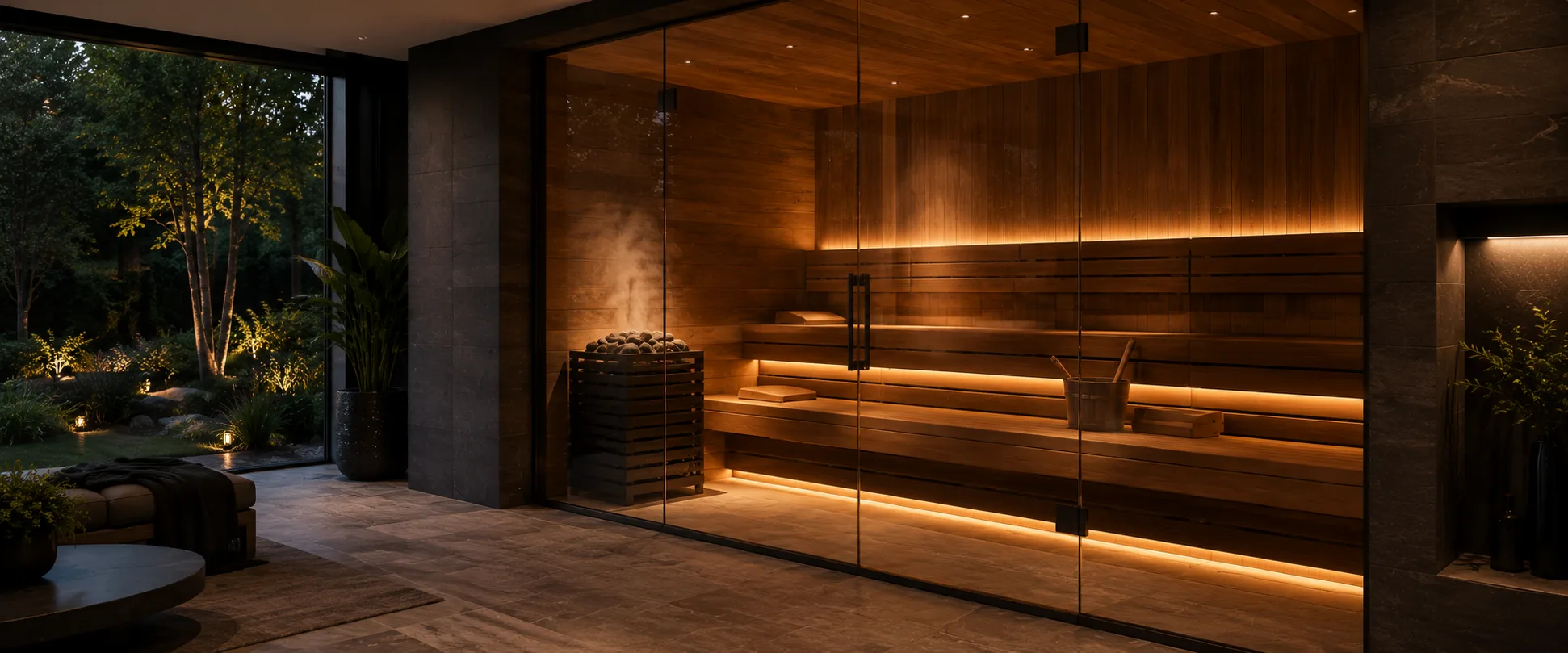
How to Choose the Right Home Sauna: A Practical Buying Guide
Choose a home sauna that fits your preferred heat experience, available space, installation limits, budget and long-term ownership priorities.
What Makes a Home Sauna the Right Choice?
The right home sauna is not necessarily the model with the longest feature list, the highest temperature, or the most expensive materials. It is the sauna that matches the way you want to use it, fits the space and infrastructure your home can realistically support, and still makes sense once installation and long-term ownership are included.
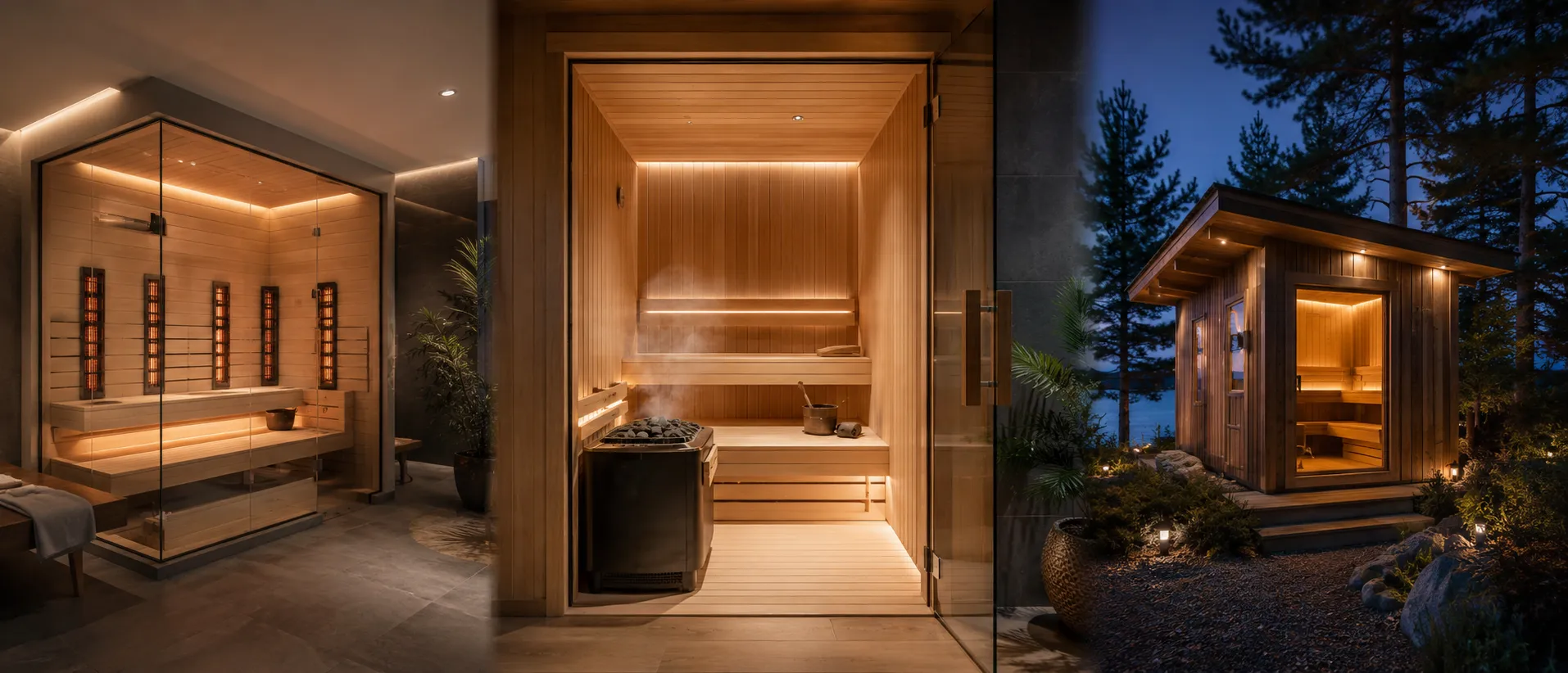
Start with the experience you want rather than a brand or model. Traditional saunas deliver high heat, hot stones, and the option to create löyly with water. Infrared cabins use radiant heat at lower air temperatures and can be easier to integrate into some homes. Outdoor cabins create a more separate sauna environment but add site, weather, access, and utility considerations. None of these formats is automatically better for every buyer.
From there, the practical constraints begin to narrow the field. How many people will actually use the sauna? Do you want enough bench length to lie down? Will it sit indoors or outdoors? What electrical service is available? How much installation work are you willing to take on? And does your budget cover the complete project rather than only the cabin price? Answering those questions before comparing individual products eliminates many poor-fit options early.
This guide is designed as a decision framework rather than another list of sauna features. We will move from heat experience and placement through capacity, construction format, installation complexity, budget, build quality, ownership, and useful premium features. The goal is to finish with a much smaller shortlist of sauna types and products that fit your home instead of trying to compare every model on the market at once.
1. Start With the Sauna Experience You Actually Want
Before comparing brands, wood species, controls or premium features, decide what kind of heat experience you want to use regularly. That single choice will eliminate a large part of the market and shape almost every decision that follows.
Traditional electric sauna
A traditional electric sauna is the best starting point if you want the classic high-temperature sauna experience: heated stones, dry heat that can be softened with water, and the ability to create short bursts of humidity through löyly.
This format generally makes the most sense for buyers who care about the traditional sauna ritual and want more control over the balance between temperature and humidity. The trade-off is that installation is usually more involved than with a simple plug-in infrared cabin, especially once heater output, electrical supply, ventilation and room volume are considered.
If you are still deciding between these two main heat formats, our infrared sauna vs traditional sauna guide compares the experience, installation requirements, heat profile and ownership trade-offs in more detail.
Infrared sauna
Infrared saunas use radiant energy to warm the body while operating at lower air temperatures than a traditional sauna. For some buyers, that makes longer sessions feel more comfortable and can simplify placement where a full traditional sauna installation would be impractical.
The category varies widely, however. Panel placement, heater type, cabin dimensions, electrical requirements and control systems can differ significantly between models. A higher feature count does not automatically mean a better infrared sauna, so the underlying construction and usable interior space matter more than marketing labels alone.
Wood-burning sauna
A wood-burning sauna is a more specialized choice. It can deliver an exceptionally traditional experience and is particularly attractive for outdoor cabins, rural properties and locations where a large electrical heater would be inconvenient.
In return, ownership is more hands-on. You need to account for the stove, chimney or flue, combustible clearances, fire protection, fuel storage, ash removal and local installation requirements. For many suburban or indoor projects, an electric heater will be the simpler option even if wood heat is more appealing in theory.
Hybrid sauna
Hybrid saunas combine more than one heat technology, most commonly traditional heat with infrared. They can be useful when two people in the same household prefer different sauna styles or when you genuinely expect to use both modes.
Do not pay a large premium for hybrid capability simply because it sounds more versatile. Check whether each heating system is independently useful, whether the cabin performs well in both modes, and whether the added electronics or proprietary components make future service more complicated.
2. Match the Sauna to Your Home
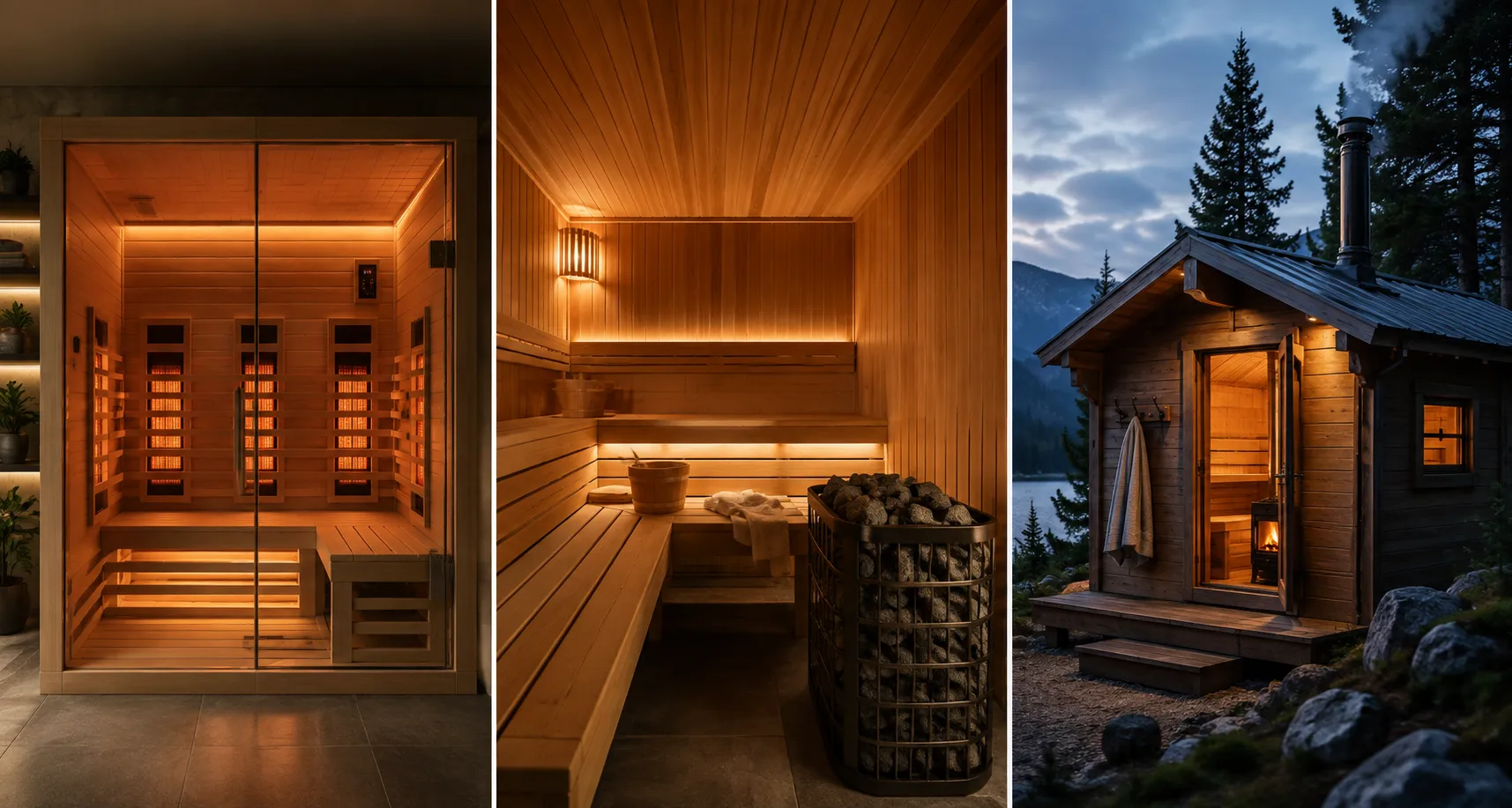
Once you know which heat experience you prefer, the next question is where the sauna can realistically live. Placement affects installation complexity, daily convenience, available size, weather exposure and how often you are likely to use it.
Indoor sauna
An indoor sauna is usually the most convenient choice for regular use because it can sit close to a shower, bathroom, changing area or home gym. It also avoids direct exposure to rain, snow and large seasonal temperature swings.
The main limitation is space. A room that appears large enough on paper may become much tighter once you account for the sauna exterior, door swing, electrical access, ventilation, required clearances and comfortable circulation around the cabin.
Indoor installations work especially well when the sauna can become part of an existing wellness area rather than being squeezed into an inconvenient leftover corner.
Basement, garage or dedicated wellness room
Basements and garages can provide more usable floor area than the main living space, but they should not be treated as automatically suitable. Check ceiling height, floor condition, moisture management, ventilation, electrical service and access for delivery before choosing a cabin.
A dedicated wellness room gives you the most freedom to coordinate the sauna with a shower, cold plunge, relaxation area or other recovery equipment. If you are planning the room from scratch, it is usually easier to design the utilities and circulation around the sauna than to adapt the sauna to a finished room later.
Outdoor sauna
An outdoor sauna makes sense when indoor space is limited, when you want a larger cabin, or when the sauna itself is meant to feel like a separate backyard retreat. It can also give you more flexibility with traditional electric or wood-burning configurations.
The trade-off is that the project extends beyond the sauna cabin. Foundation or base preparation, drainage, electrical routing, weather exposure, roof and exterior maintenance, winter access and local requirements can all become part of the decision.
If you are choosing between these two placement strategies, our indoor vs outdoor sauna guide compares installation, climate exposure, maintenance, convenience and long-term ownership in more detail.
Choose for frequency of use, not just appearance
A dramatic backyard cabin may look more appealing than an indoor unit, but the better choice is the one you will use consistently. Think about the full routine: changing, walking to the sauna, showering, cooling down and returning indoors in summer, rain or freezing weather.
For many buyers, convenience is more valuable than a larger cabin. For others, separating the sauna from the house is part of the experience. Neither is inherently better; the right answer depends on how the sauna will fit into your normal week.
3. Size the Sauna for How You’ll Actually Use It
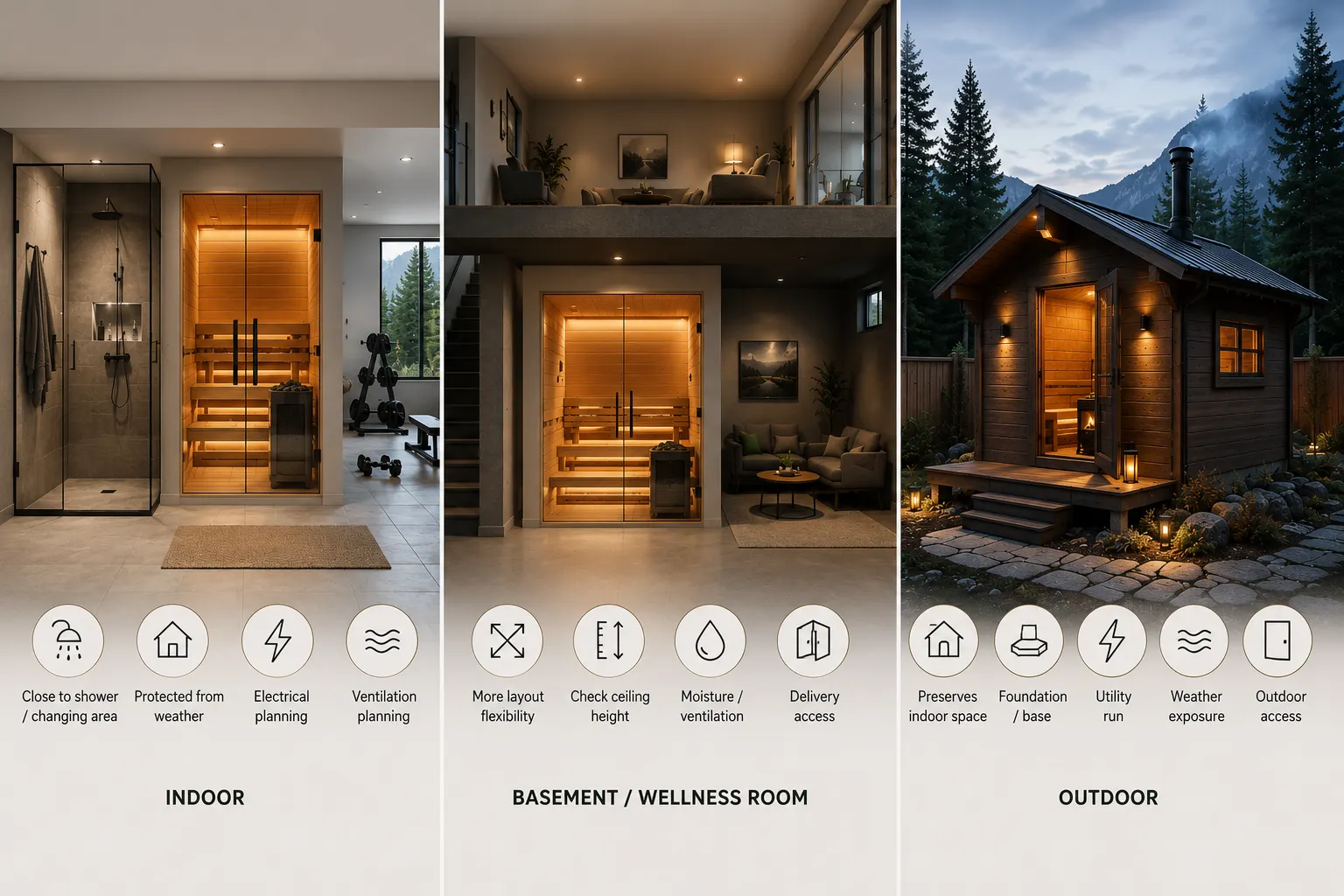
Sauna capacity is useful for narrowing the market, but the number in the product name does not tell you how comfortable the cabin will feel. Start with the people, seating positions and session habits you expect most often, then check the actual interior dimensions.
For one or two people
A compact one- or two-person sauna can be the most practical choice when floor space is limited and most sessions will be solo or shared with one other person. Smaller cabins are easier to integrate into bathrooms, gyms and other finished interior spaces, and they avoid paying for capacity you rarely use.
Do not judge comfort by the advertised headcount alone. Check shoulder room, bench depth, legroom, door position and whether two adults can sit naturally without feeling crowded. This matters especially with compact infrared cabins, where heater panels and interior components can reduce usable space.
For couples who want more room
If two people will use the sauna regularly, moving up one size can be worthwhile even when a smaller model technically accommodates two adults. Extra bench length and floor area can make sessions noticeably more comfortable and may give you more freedom to change seating position.
This is also where the difference between exterior dimensions and usable interior space becomes important. Two cabins with similar footprints can feel very different once bench geometry, heater placement, glass area and wall construction are taken into account.
For families, guests or room to lie down
Larger cabins make more sense when several people will use the sauna together, when you expect to entertain, or when lying down is an important part of the experience. In these cases, bench layout is often more useful than the manufacturer’s person rating.
Look at the length and depth of the usable benches, the number of seating levels and how much circulation space remains once the heater and guards are installed. A nominal four-person sauna may be comfortable for four seated users yet still lack a bench long enough for an adult to recline.
Measure the installation space before choosing the cabin
The sauna itself is only part of the footprint. You may also need room for assembly, required clearances, electrical access, ventilation, door operation and future service. Outdoor models can add foundation dimensions and access around the exterior to the planning process.
Our sauna sizes and dimensions guide explains typical cabin footprints, ceiling height, bench space and installation clearances in more detail. Use those measurements to define the largest practical sauna for your space before building a shortlist of models.
Room size also affects heater sizing
For traditional saunas, larger is not automatically better. Increasing the room volume also increases the heating requirement, and glass, masonry or other less-insulated surfaces can affect the heater capacity the room needs.
Once you know the proposed interior dimensions, use our sauna heater size calculator to estimate the heater range that fits the room before comparing individual electric heaters or traditional sauna packages.
4. Choose the Right Construction Format
Two saunas can use the same heat type and occupy a similar footprint while requiring very different levels of planning, installation and customization. The construction format is what often determines how simple—or involved—the project becomes.
Prefab sauna cabins
Prefabricated cabins are the most straightforward option for many homeowners. The major components are designed to work together as a system, which reduces the number of decisions you need to make about walls, benches, doors, controls and heater placement.
They are especially attractive when you want predictable dimensions and a relatively defined installation process. The limitation is flexibility: you are working within the manufacturer’s available sizes, layouts, materials and equipment options rather than designing the room around your exact space.
Modular sauna kits
Modular kits sit between a finished cabin and a fully custom sauna. Depending on the system, they may arrive as pre-cut or pre-built wall and ceiling sections that are assembled on site, giving you some of the predictability of a prefab product while allowing more flexibility in size and configuration.
The important question is what the kit actually includes. Heater, controls, lighting, flooring, exterior finishing, electrical components and installation labor may be bundled differently from one manufacturer to another. Compare the complete scope rather than the advertised kit price alone.
Custom-built sauna rooms
A custom sauna gives you the most control over dimensions, bench geometry, materials, glazing, lighting and how the room integrates with the surrounding architecture. It is often the strongest option for a high-end wellness room or an unusual space where standard cabin dimensions create compromises.
That flexibility also creates more responsibility. Insulation, vapor management, ventilation, heater sizing, electrical work, clearances and interior detailing all need to work as one system. A visually impressive custom room can still perform poorly if the underlying sauna design is wrong.
Choose based on how much customization you actually need
Do not assume custom is automatically better, or that prefab means lower quality. A well-designed premium cabin can be a better purchase than an unnecessarily complicated custom project, particularly when standard dimensions already fit your space and use case.
Prefab is usually the logical starting point when simplicity and predictability matter most. Modular systems make sense when you need more flexibility without designing everything from scratch. Custom construction earns its premium when the architecture, dimensions or desired sauna experience genuinely require it.
5. Decide How Much Installation You’re Willing to Take On
Installation can be the difference between a relatively simple sauna purchase and a small construction project. Before choosing a model, decide how much electrical work, site preparation, assembly and contractor coordination you are comfortable taking on.
Lower-complexity installations
Some compact infrared saunas are designed for comparatively simple indoor installation. Depending on the model, the main work may be assembling the cabin, providing the required power supply and confirming that the finished space has enough clearance and ventilation.
Simple does not mean assumption-free. Verify the manufacturer’s electrical requirements, outlet or circuit specifications, room conditions and assembly access before ordering. A sauna that fits the final location still needs to fit through the route used to get it there.
Moderate-complexity installations
Many traditional electric sauna cabins and larger prefab systems require more planning. A dedicated electrical circuit, hardwired heater, control equipment or professional assembly may be part of the project. Our guide to home sauna electrical requirements explains 120V vs 240V, amperage, dedicated circuits and wiring considerations in more detail, while the installation area still needs to satisfy the manufacturer’s requirements for the specific sauna and heater.
This is where it becomes important to separate the sauna purchase price from the installed project cost. Electrical work, delivery, assembly and small modifications to the room can materially change the final amount even when no major construction is required.
Higher-complexity installations
Custom sauna rooms and many outdoor installations can involve several trades or site decisions. Framing, insulation, vapor management, flooring, ventilation, electrical service, drainage, foundations, weather protection and heater clearances may all become part of the project.
Wood-burning saunas add another layer because the stove, chimney system, combustible clearances and local requirements need to be addressed correctly. The appeal can be substantial, but it should be treated as a deliberate installation choice rather than a simpler substitute for an electric heater.
Check the site before you commit to a sauna
The safest buying sequence is to confirm the proposed location first, then verify the requirements of the sauna you are considering. Check available power, access, floor conditions, ventilation, required clearances and any outdoor site work before placing the order.
Our guide to what to know before buying a home sauna covers the installation questions worth resolving before purchase, including electrical planning, ventilation, flooring, moisture, ceiling height, warranty and service access.
6. Set Your Total Project Budget
The price of the sauna is not always the price of the finished project. Set a budget for the complete installation—including the cabin or materials, heater, electrical work, delivery, site preparation and professional labor—before deciding how much you can spend on the sauna itself.
A compact infrared cabin installed in a prepared indoor space can have relatively few additional costs. A larger traditional sauna, outdoor cabin or custom room can require a much broader project budget. The useful question is therefore not simply “How much sauna can I afford?” but “How much can I spend once the sauna is fully installed and ready to use?”
| Total project budget | What it can realistically target | Watch for |
|---|---|---|
| Under $5,000 | Compact infrared cabins, entry-level sauna kits or smaller projects where the installation space and electrical supply are already suitable. | Delivery, assembly, electrical changes and low advertised prices that exclude important components. |
| $5,000–$10,000 | A broader range of infrared and traditional prefab saunas, better materials and larger capacities with room for moderate installation costs. | Dedicated circuits, heater and control upgrades, freight, professional assembly and room preparation. |
| $10,000–$20,000 | Premium prefab systems, larger traditional cabins, many outdoor saunas and higher-specification installations. | Foundations, longer electrical runs, site access, exterior work and premium options that can push the completed project above the initial estimate. |
| $20,000+ | High-end outdoor installations, architectural sauna rooms and custom projects with greater control over materials, glazing, layout and surrounding wellness space. | Contractor scope, structural or site work, custom fabrication, permitting where applicable and the cost of integrating the sauna with the rest of the space. |
These ranges are planning bands rather than fixed market prices. The finished cost can vary substantially with sauna type, size, location, electrical requirements, site conditions, delivery and labor.
Real Sauna Examples Across Different Budgets
These examples are tied to Topture product SKUs rather than hardcoded retailer URLs. Price, availability, shipping and the product link are pulled from the imported product feed.
Finnmark FD-1
- Price
- $4,695
- Availability
- In stock
- Shipping
- Free
A compact full-spectrum infrared cabin that represents the lower end of the product-price spectrum. It can fit below a $5,000 sauna purchase budget while keeping the installation footprint relatively modest.
View Finnmark FD-1SaunaLife E7 Glass Front
- Price
- $6,190
- Availability
- In stock
- Shipping
- $950 flat rate
A four-person outdoor barrel sauna with a glass front that moves the purchase price into the mid-range. The finished project still needs an exterior base, delivery access and a suitable heater and electrical plan.
View SaunaLife E7 Glass FrontSaunaLife GL6
- Price
- $12,790
- Availability
- In stock
- Shipping
- $950 flat rate
A larger six-person outdoor sauna kit that illustrates how capacity and a more substantial structure can move the product price above $10,000 before site preparation, utilities and installation are added.
View SaunaLife GL6Affiliate links. Product data is pulled dynamically from the imported Topture feed and can change. Product price is not the same as total installed project cost.
Want to compare manufacturers before choosing a model? Browse our sauna brand guides.
Keep part of the budget outside the sauna price
Spending the entire budget on the cabin can leave too little room for the work required to make it usable. Before ordering, identify which costs are included in the quoted price and which will be paid separately.
Common additions include electrical work, heater or control packages, freight, assembly, foundation or floor preparation, ventilation work and contractor labor. Our guide to how much a home sauna costs breaks down the purchase and installation expenses in greater detail.
Compare quotes by total scope, not headline price
Two quotes with very different prices may not include the same work. One may cover the sauna package only, while another includes delivery, heater controls, site work or installation. A lower number is not necessarily the lower-cost project if major items still need to be added later.
Before comparing offers, normalize what is included and identify anything that remains unpriced. That gives you a much better basis for deciding whether a quote fits your actual project budget.
7. Know What Actually Separates a Good Sauna From a Mediocre One
Once you have narrowed the field by sauna type, location, size, installation and budget, the next step is judging quality. A longer feature list does not necessarily mean a better sauna. The fundamentals—heat, construction, usable space, ventilation and long-term support—matter more.
Start with the heating system
In a traditional sauna, look beyond the heater’s maximum temperature. The heater should be appropriately sized for the room and capable of producing stable, even heat without being pushed unnecessarily hard. Stone capacity, controls and the way the heater integrates with the room can also affect the experience.
For infrared saunas, compare the heating system rather than relying on labels such as “full spectrum” alone. Panel placement, coverage, control and how evenly the cabin heats your body are more useful considerations than the number of marketing terms attached to the emitters.
Pay attention to usable space, not just exterior dimensions
Two saunas with similar exterior dimensions can feel very different inside. Bench depth, bench height, foot space, heater guards, door swing and glass placement all affect how much of the cabin is actually comfortable to use.
Sit-down capacity can also be misleading if you expect to stretch out or lie down. Check the interior dimensions and bench layout against the way you plan to use the sauna rather than assuming the advertised person count tells the whole story.
Construction quality matters where you cannot immediately see it
Attractive wood and large glass panels are easy to compare in photographs. Insulation, wall construction, door fit, hardware, fastening, weather protection and the quality of the underlying structure are less obvious but can matter more over years of ownership.
Outdoor saunas deserve particular scrutiny because the enclosure must also deal with rain, snow, temperature swings and prolonged exposure to the elements. The exterior shell, roofing approach, base requirements and weather detailing should make sense for the climate where the sauna will be installed.
Ventilation and heat distribution should be part of the design
A sauna should not depend on raw heater output alone. Airflow, heater position, bench arrangement and room geometry work together to determine how the space feels once it is operating.
Before buying, check how the manufacturer expects fresh air to enter and leave the sauna and whether those requirements are compatible with your planned installation. This is especially important when a prefab cabin is being placed inside an existing room. Our sauna ventilation requirements guide explains intake and exhaust placement, airflow methods and the installation details that affect proper ventilation in more detail.
Check certification, warranty and replacement parts before premium features
Electrical equipment should be appropriate for the market where the sauna will be installed, and the documentation should clearly explain the required electrical setup. If certification, wiring requirements or installation responsibilities are unclear, resolve them before ordering.
Then look at what happens after the sale. Compare warranty coverage for the cabin, heater, controls and other major components, and find out whether replacement parts can be sourced without replacing an entire system. A strong warranty is more useful when the manufacturer or dealer also has a practical process for service and parts support.
Premium lighting, app control, audio and other upgrades can improve the ownership experience, but they should come after the fundamentals. If the sauna heats well, fits the users comfortably, is properly built for its location and can be serviced years from now, you have a much stronger foundation for comparing the features that are actually worth paying for.
8. Decide Which Features Are Actually Worth Paying For
Once the fundamentals are right, features become a matter of convenience, atmosphere and personal preference. Some upgrades can make a sauna noticeably easier or more enjoyable to use. Others add cost without changing the core sauna experience very much.
Prioritize controls you will actually use
Better controls can be worth paying for when they make regular sauna use simpler. A clear digital controller, useful scheduling options and convenient temperature adjustment can matter more in daily ownership than a long list of secondary features.
Wi-Fi and app control can also be useful, particularly when the sauna takes time to heat and you want it ready before a session. But remote operation should be evaluated alongside the manufacturer’s safety requirements, electrical setup and control-system design—not as a reason by itself to choose one sauna over another.
Lighting and glass can improve the room more than gadgets do
Good interior lighting can make a sauna feel substantially more refined without changing how it heats. Indirect or under-bench lighting is generally more useful than harsh fixtures positioned directly in the line of sight.
Glass frontage can make a compact cabin feel more open and visually lighter, especially in an indoor wellness room. The tradeoff is that larger glazed areas can affect privacy, thermal performance and the heater requirement, so appearance should still be considered as part of the overall room design.
Treat wellness add-ons as separate benefits
Red light systems, chromotherapy, audio packages and similar upgrades may be attractive, but they should not be used as substitutes for evaluating the sauna itself. If a feature matters to you, compare what is actually included, how it is integrated and whether it can be serviced or replaced later.
This is particularly important with proprietary electronics. A simple feature that remains repairable can be more valuable over time than an elaborate system that depends on a single app, controller or replacement module.
Spend on comfort before novelty
If you have room in the budget, upgrades that improve physical comfort are often easier to justify than novelty features. Better bench geometry, a more comfortable backrest, useful interior space, well-positioned controls and thoughtful lighting can affect nearly every session.
The best feature package is therefore not the one with the longest specification sheet. It is the one that supports the way you expect to use the sauna while keeping the core heating system, construction and serviceability strong.
9. Think About Ownership Before You Buy
A home sauna is a long-term purchase, so the buying decision should extend beyond delivery day. Before choosing a model, consider what it will cost to run, how it will be maintained and what happens if a heater, controller or other important component eventually needs service.
Understand the ongoing costs
Electricity use depends on heater power, session length, warm-up time, local energy rates and how often you use the sauna. Larger traditional saunas generally require more energy per session than compact cabins, but purchase price alone does not tell you what ownership will cost.
If running cost matters to your decision, use our Sauna Operating Cost Calculator to estimate electricity use based on your own heater, usage pattern and energy rate.
Check service and replacement parts
Find out whether heaters, controls, sensors, infrared components, door hardware and other serviceable parts can be purchased separately. This matters more as the sauna ages and can be especially important with proprietary electronic systems.
Also consider who will actually provide support. A long warranty is less reassuring if replacement parts are difficult to source or there is no clear service process in your region.
Read the warranty by component, not just by headline length
Warranty terms may differ between the cabin, heater, controls, infrared emitters and other components. Check what is covered, for how long, whether labor or freight is included and whether professional installation is required to maintain coverage.
The goal is not necessarily to find the longest warranty. It is to understand whether the parts most likely to matter during ownership have practical coverage and a realistic path to repair or replacement.
10. Build Your Sauna Shortlist
By this point, you should know the heat experience, size, location, installation scope and budget that fit your home. Use those requirements to narrow the market to a small group of brands and models that genuinely match the project rather than comparing every sauna you can find.
Compare sauna brands side by side by price range, sauna type, market availability and other buying factors.
How to Make the Final Decision
The right home sauna is not necessarily the most expensive model or the one with the longest feature list. It is the sauna that fits the experience you want, the space you actually have, the installation your home can support and the amount you are comfortable spending on the complete project.
Start with the fundamentals: choose the heat type, decide whether the sauna belongs indoors or outdoors, size it for the people who will really use it and confirm the electrical, ventilation and site requirements before ordering. Then compare construction quality, heater performance, usable interior space, warranty coverage, replacement parts and manufacturer support.
Once those requirements are fixed, features and finishes become much easier to judge. Pay extra for the upgrades that improve comfort or make the sauna easier to use, but do not let lighting, apps or other extras distract from a stronger heating system, better construction or a more practical layout.
Your final shortlist should be small. If two or three models meet the same core requirements, compare them by total installed cost and long-term ownership rather than headline price alone. That approach gives you a much better chance of choosing a sauna that still feels like the right purchase years after installation.
Home sauna buying questions
What size home sauna should I buy?
Start with the number of people who will actually use the sauna together, then check the interior bench dimensions rather than relying only on the advertised person capacity. Two saunas sold for the same number of users can provide very different amounts of usable sitting or lying space.
How much space do I need for a home sauna?
You need enough space for the sauna itself plus the clearances, door operation, ventilation, electrical access and installation requirements specified for the exact model. Outdoor installations may also require site preparation, a suitable base and additional access around the structure.
How do I know what size sauna heater I need?
Heater sizing should be based on the sauna room volume and adjusted for heat-loss surfaces such as glass, stone or other uninsulated areas. Do not choose a heater from floor area alone, and always confirm the final result against the heater manufacturer’s approved room-volume range.
For an initial estimate, use the Verdict Lux Sauna Heater Size Calculator .
Does a home sauna need a dedicated electrical circuit?
Many electric sauna heaters and some complete sauna systems require a dedicated circuit, but the voltage, amperage, breaker size, conductor requirements and control wiring are model-specific. Verify the electrical documentation for the exact sauna and heater before purchase and have the installation completed according to applicable local requirements.
Does a home sauna need ventilation?
Yes, ventilation is part of the sauna system. Supply and exhaust locations depend on the sauna, heater and whether the installation uses gravity or mechanical exhaust ventilation. Final vent openings should follow the current instructions for the exact equipment rather than a generic diagram.
Do I need a floor drain in a home sauna?
Not every home sauna requires a floor drain, but the floor still needs to suit the manufacturer’s installation requirements and the way the room will be used. Water use, cleaning method, moisture exposure and the surrounding room all matter, so the floor and moisture strategy should be decided before the sauna is delivered.
What changes when a sauna is installed outdoors?
Outdoor installation adds exposure to weather, drainage, foundation or base requirements, exterior clearances and site access. Electrical routing and local permitting can also differ. A sauna intended only for indoor use should not be moved outdoors unless the manufacturer specifically approves that installation.
How much does a home sauna cost to run?
Operating cost depends primarily on the equipment’s rated power, warm-up time, session length, usage frequency and your electricity tariff. A larger heater does not automatically mean proportionally higher real-world cost, because actual use patterns and warm-up time also affect consumption.
For a model-specific estimate, use the Verdict Lux Sauna Operating Cost Calculator .
What should I check in a sauna warranty before buying?
Read the actual warranty for the sauna, heater, controls and other major components rather than relying on a headline warranty length. Check what is covered, how long each component is covered, whether labor or shipping is included, what can void coverage and how claims are handled in your region.
What matters most when choosing between two home saunas?
Compare the complete projects rather than the product pages. If both saunas deliver the experience you want, compare usable bench space, installation requirements, total installed cost, warranty, replacement-part availability and long-term service support. Design and convenience features should break the tie only after those fundamentals work.
Sources & methodology
This guide is supported by current sauna-industry guidance, manufacturer technical documentation and U.S. certification resources covering the criteria that matter before a home sauna is ordered. The sources below support the buying framework itself rather than serving as endorsements of individual products.
Verdict Lux treats this article as a decision framework rather than a product ranking. We reviewed guidance covering sauna type, room and bench geometry, heater sizing, ventilation, electrical and certification considerations, indoor and outdoor placement, and wood-burning installation requirements, then used those criteria to structure the buying process in this guide. Manufacturer technical documentation is used for model-dependent installation requirements, while sauna-industry and regulatory sources provide broader planning and certification context. Product examples, prices and availability shown in the guide are pulled separately from the imported Topture product feed and are not used as evidence for the technical recommendations. Verdict Lux has not hands-on tested every sauna or installation discussed in this guide.
Use this framework to narrow the sauna type, size and installation approach that fit your home, then verify the exact model dimensions, heater range, power supply, clearances, ventilation, site conditions and warranty in the current manufacturer documentation before ordering. Local electrical, building and fire requirements can differ by jurisdiction, so model-specific instructions and qualified local professionals should take priority over general planning guidance.