How Much Does a Home Sauna Cost?
A practical breakdown of home sauna prices, installation costs, electrical work and ongoing expenses with real pricing context from the sauna brands tracked by Verdict Lux.
How much should you budget for a home sauna?
The price of a home sauna can vary dramatically depending on the type of sauna, its size, heating system, materials and where it will be installed. A compact infrared cabin or portable sauna may require little more than the purchase price and a suitable power connection, while a larger traditional or outdoor sauna can involve electrical work, site preparation, delivery, assembly and other project costs before it is ready to use.
That is why the listed price of the sauna itself is only the starting point. In this guide, we separate the budget into the cost of the sauna, the additional expenses that can come with installation, and the ongoing costs of ownership. Product pricing is based on current sauna brands tracked by Verdict Lux, while installation-related figures are presented as planning references rather than universal contractor quotes.
What does the sauna itself cost?
Sauna prices vary enormously because a portable tent, an infrared cabin, a traditional indoor sauna and a large outdoor installation are very different products. The ranges below reflect pricing found across the sauna brands tracked by Verdict Lux. They represent the sauna product itself, not a universal installed project price. For a broader fixed-cabin benchmark, our 2026 U.S. home sauna market analysis found a median advertised price of $6,999 across 370 publicly priced models.
Portable sauna systems are the least expensive category we track. Price differences usually come from tent size, stove package, materials and included accessories.
- Typical format
- Sauna tent or portable enclosure
- Main price drivers
- Size, stove, materials, accessories
Infrared cabins cover one of the widest residential price ranges. Entry models can begin below $2,000, while premium cabins with larger capacities, upgraded wood and more advanced heater systems can move close to or beyond $10,000.
- Typical format
- One to four person indoor cabin
- Main price drivers
- Capacity, wood, heater technology, brand
Traditional indoor pricing depends heavily on size and what the package includes. Smaller prefabricated rooms can start around $4,000, while larger residential models can exceed $16,000 before electrical work or installation is added.
- Typical format
- Indoor room kit or prefabricated cabin
- Main price drivers
- Size, heater, wood, glazing, room construction
Outdoor barrel, cabin and prefabricated saunas span a large range. Compact barrel models can sit near the lower end, while larger cabins with premium materials, glazing and upgraded heater packages can move beyond $20,000.
- Typical format
- Barrel, cabin or outdoor prefab room
- Main price drivers
- Size, structure, heater, wood, glazing
Premium residential sauna pricing can move well beyond the ranges of standard indoor and outdoor cabins. Larger architectural rooms, premium materials and highly specified systems can push the sauna itself above $20,000 before project-specific installation costs are included.
- Typical format
- Large premium cabin or complete sauna room
- Main price drivers
- Architecture, materials, size, customization
What can the rest of the project add?
The sauna price is only the starting point. Electrical work, site preparation, delivery and assembly can all change the final number, especially with traditional electric and outdoor installations.
The important part is not to add every cost below to every project. An infrared cabin going into a finished room may need very little additional work. A large outdoor sauna with a long electrical run and a new foundation is a very different project.
Before estimating these additional costs, our guide to what to know before buying a home sauna explains the installation, electrical, ventilation requirements, space and delivery requirements worth checking before you choose a model.
| Project cost | Planning range | When it matters | What moves the number |
|---|---|---|---|
| Dedicated electrical circuit | $570–$1,100 | Traditional electric heaters commonly need a dedicated circuit. | Wire length, amperage, access and distance from the main panel. |
| Electrical inspection | $100–$400 | Inspection may be required after new electrical work. | Local requirements and the scope of the electrical installation. |
| 200A panel upgrade | $1,300–$3,000 | Only when the existing electrical system needs additional capacity. | Panel size, installation complexity and additional electrical work. |
| Outdoor concrete base | $6–$12 / sq. ft. | One possible foundation option for an outdoor sauna. | Excavation, grading, thickness, reinforcement and access. |
| General assembly labor reference | $50–$150 / hour | A general labor reference when owner or dealer assembly is not included. | Location, professional experience, project size and complexity. |
| Delivery | Varies by brand | Especially important for large cabins and remote locations. | Freight policy, distance, curbside service and difficult access. |
| Ventilation and room preparation | Project specific | More relevant to built-in indoor saunas than simple plug-in cabins. | Existing room condition, flooring, ventilation and moisture management. |
Electrical circuit and inspection: Angi 200A panel: This Old House Concrete slab: HomeGuide General labor: HomeAdvisor
These are current U.S. national planning references checked in August 2026, not sauna-specific contractor quotes. Local labor rates, electrical requirements and site conditions can materially change the actual project cost.
Electrical work is the first number to check
For many traditional electric saunas, the electrical installation is the first meaningful cost outside the sauna itself. Current national planning data puts a new dedicated circuit at roughly $570 to $1,100. The actual quote can move higher when the sauna is far from the main panel or the wiring route is difficult.
A panel upgrade is a different issue. It should not be added automatically to every sauna budget. If the existing service has enough capacity and breaker space, you may not need one at all. When a 200 amp upgrade is necessary, current planning data puts the project at roughly $1,300 to $3,000.
- Review the electrical requirements for a home sauna to understand 120V vs 240V, amperage, dedicated circuits and wiring, then get the heater’s exact requirements before asking for an electrician quote.
- Measure approximately how far the sauna will sit from the main panel.
- Ask whether permits and inspection are included in the electrician’s price.
Outdoor saunas shift part of the budget to the site
An outdoor sauna may arrive as a complete structure, but the site underneath it still matters. Some installations can use an existing suitable patio or prepared base. Others may require grading, gravel, pavers or a concrete slab.
For context, current national pricing for a basic installed concrete slab averages roughly $6 to $12 per square foot. That does not mean every sauna needs concrete. The manufacturer’s foundation requirements should decide the solution, not a generic cost guide.
Before buying an outdoor sauna, confirm three things:
- What foundation does the manufacturer require?
- Can the delivery vehicle and crew reach the installation area?
- How will electrical power or a wood-burning chimney be handled?
Delivery deserves its own line in the budget
This is one area where a single national dollar figure would be misleading. In the Verdict Lux brand data, some product prices include delivery while others are unit-only prices. Large cabins can also be handled very differently from compact indoor units.
Before comparing two sauna prices, check whether both quotes actually include the same level of delivery service.
- Is freight included in the listed price?
- Is the service curbside only?
- Who unloads the sauna?
- Is placement at the installation site included?
- Is assembly part of the quote?
What does a home sauna actually cost once everything is included?
The gap between the sauna price and the finished project can be small or substantial. It depends on what you buy, where it goes and how much work the home needs before the sauna can be used.
The examples below are planning scenarios, not national averages. They combine representative sauna prices with the electrical, labor and site costs discussed above to show how a product price can turn into a more realistic project budget.
| Example project | Sauna price | Example additional costs | Planning total |
|---|---|---|---|
| 2-person infrared cabin Existing suitable indoor space | ~$3,000 | Minimal if the required power, delivery access and installation conditions are already in place. | From about $3,000 |
| Traditional indoor sauna Electric heater | ~$8,000 | Dedicated circuit, permit or inspection, and professional assembly if required. | ~$8,700–$11,000+ |
| Outdoor sauna cabin New backyard installation | ~$12,000 | Site preparation, foundation, electrical work, delivery and assembly depending on the property. | ~$13,500–$17,000+ |
These examples are illustrations built from the product and project-cost ranges used in this guide. They are not quotes. A panel upgrade, difficult freight access, extensive site work or a long electrical run can push the final cost beyond these examples.
A $3,000 infrared sauna can stay surprisingly close to $3,000
Infrared cabins can be relatively straightforward projects when the room is already suitable for the sauna. If the model can use the available electrical supply, the packaged sections fit through the home and the owner handles straightforward assembly, there may be relatively little to add to the advertised price.
That simplicity is part of the appeal of this category. You are buying a finished cabin rather than creating a traditional hot room around a separate sauna heater.
It still pays to check the details before ordering. A larger infrared model may have different electrical requirements, and freight or professional assembly can still add to the bill.
An $8,000 traditional sauna can become an $11,000 project
Traditional electric saunas introduce another part of the budget: the heater installation. If a new dedicated circuit is required, the electrician becomes part of the project before the first sauna session ever happens.
Using the planning ranges above, an $8,000 sauna plus a typical new dedicated circuit already moves the project beyond the advertised price. Add permits, inspection or professional assembly and a total around $9,000 to $11,000 becomes easy to understand.
The expensive exception is a home that also needs electrical service work. A panel or service upgrade can add another four-figure expense, which is why electrical capacity is worth checking before choosing the sauna rather than after it arrives.
- Confirm the exact heater included with the sauna.
- Give the heater specifications to an electrician before ordering.
- Keep any panel upgrade separate from the basic sauna installation estimate so you can see what is actually driving the cost.
Outdoor installations have the most variables
A $12,000 outdoor cabin tells you what the sauna costs. It does not necessarily tell you what the backyard project costs.
The installation site may already have a suitable base and convenient electrical access. If it does, the finished budget can remain much closer to the sauna price. Starting with bare ground at the far end of the property creates a very different calculation.
Foundation work, electrical distance, freight access and assembly can all affect the total. This is why two homeowners can buy the same outdoor sauna for the same advertised price and finish with noticeably different project costs.
For an outdoor sauna, get these three numbers before you buy:
- The delivered price of the sauna.
- The cost of preparing the required foundation or base.
- The cost of getting power to the final sauna location.
What makes one home sauna cost more than another?
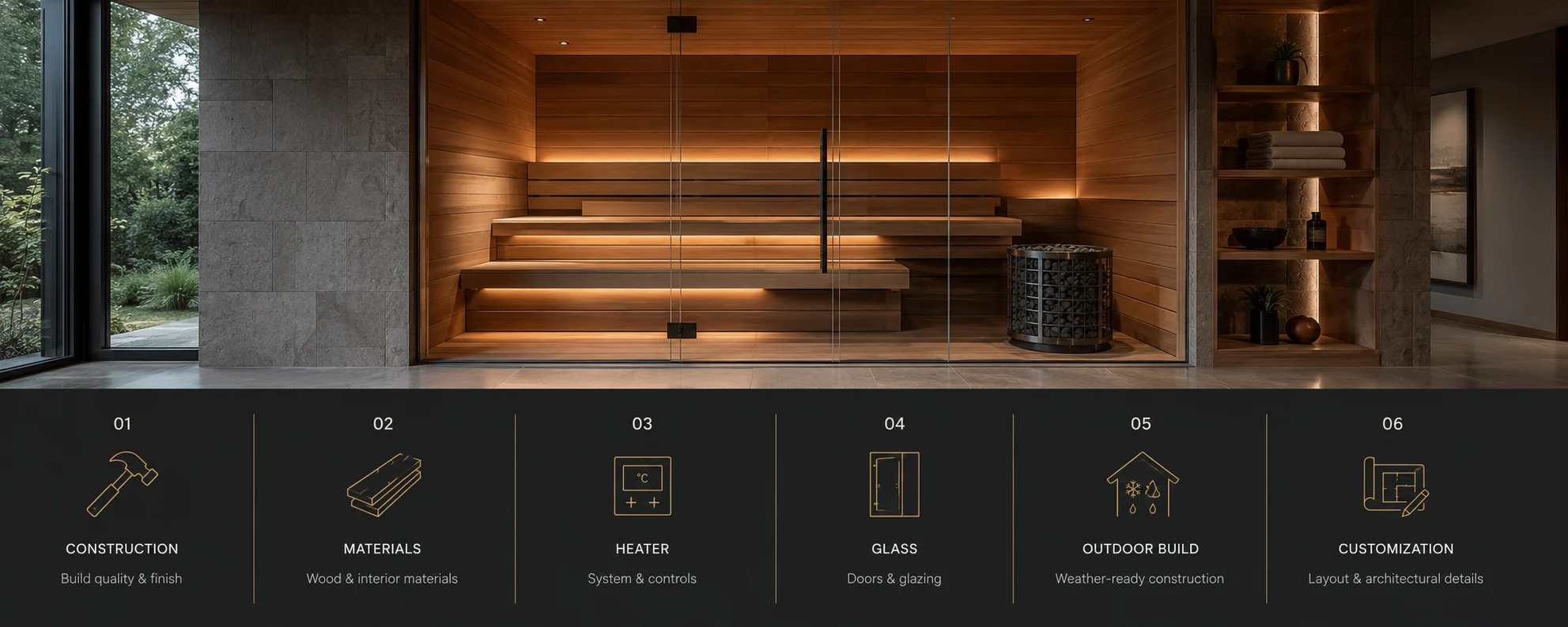
Size matters, but it does not explain the enormous price differences across the residential sauna market. Construction, materials, heater package, glazing, controls and the level of customization can matter just as much.
This is why two saunas designed for the same number of people can sit thousands of dollars apart. One may be a straightforward prefabricated cabin, while the other is built around premium materials, architectural glass and a more sophisticated heating and control system.
| What you are paying for | More basic approach | What can push the price higher |
|---|---|---|
| Construction | Standardized prefabricated cabin with fewer architectural details. | Heavier construction, more complex joinery, premium finishes and architectural detailing. |
| Wood and materials | Standard material package selected for a production model. | Premium wood choices, thermally modified materials, upgraded interiors and more elaborate exterior finishes. |
| Heater | Conventional heater sized for the room. | Larger heaters, premium stone capacity, upgraded heater designs and more sophisticated control packages. |
| Glass | Glass door or smaller window area. | Full glass fronts, corner glazing and large architectural glass surfaces. |
| Controls | Simple onboard or wall-mounted control. | Premium external controls, connectivity, remote operation and integrated lighting or climate functions. |
| Design | Fixed dimensions and a standardized interior layout. | Architectural design, unusual layouts, upgraded bench systems and made-to-order configurations. |
| Outdoor construction | Compact barrel or straightforward outdoor structure. | Larger cabin construction, roofing, exterior cladding, extensive glazing and more complex weather-resistant assemblies. |
Research basis: Verdict Lux review of published residential sauna specifications, configurations and pricing across the brands in our sauna database. Checked August 2026.
Size matters, but it does not explain everything
Larger saunas generally require more material and often need more heating capacity, so size naturally affects price. But capacity labels such as “two person” or “four person” are poor shortcuts for judging value.
Two four-person cabins can be completely different products. The amount of glass, wall construction, bench layout, heater package and quality of the finish may have more influence on the price difference than the nominal seating capacity.
That is why we would not compare saunas by price per person. It can make a simple large cabin look like better value than a smaller, substantially better specified sauna. If you are deciding how size, sauna type, installation and budget should fit together, see our How to Choose the Right Home Sauna guide.
The heater can move the price more than buyers expect
In a traditional sauna, the heater is not a minor accessory. It is central to how the room performs, and heater packages vary considerably between products.
Moving from a straightforward electric heater to a larger premium system with greater stone capacity and more advanced controls can materially increase the package price. Some sauna manufacturers also offer several heater choices for the same room, which means the advertised starting price may not represent the configuration you would actually choose.
When comparing two traditional saunas, check what is actually included:
- The heater model and rated output.
- Whether stones are included.
- The control system supplied with the heater.
- Whether a heater upgrade changes the electrical requirements.
Glass looks simple, but it changes the equation
Large glass fronts have become one of the defining features of modern residential saunas. They can make a compact cabin feel more open and allow the sauna to become part of the architecture of the room rather than a closed wooden box.
The tradeoff is that extensive glazing adds another premium component to the structure. It can also affect heater sizing because glass does not retain heat in the same way as an insulated sauna wall.
This is particularly important when comparing highly glazed models with more enclosed cabins. Similar exterior dimensions do not necessarily mean the two rooms have the same effective heating load.
Outdoor construction has to do more than look good
An outdoor sauna is not simply an indoor cabin moved into the backyard. The structure has to deal with weather exposure, and that brings the exterior shell into the buying decision.
Roof construction, exterior materials, doors, glazing and the overall building format can all affect the product price. A compact barrel and a large architectural cabin may both be sold as outdoor saunas, but they are not comparable construction projects.
This is one reason outdoor pricing spreads so widely across the market. At the upper end, you are increasingly buying a small purpose-built structure rather than simply a sauna enclosure.
Premium pricing is not always about better specifications
Once you reach the upper end of the residential market, price begins to reflect design and finish as much as basic sauna performance. Architectural glass, concealed lighting, refined interiors, unusual layouts and customization can move the price far beyond that of a standard production cabin.
That does not automatically make the more expensive sauna the better purchase. A homeowner who wants a straightforward hot room may get little practical benefit from paying heavily for architectural details. Someone integrating a sauna into a high-end home may value those same details every day.
The useful question is not simply whether a sauna is expensive. It is whether the things making it expensive are things you actually want.
How much does a home sauna cost to run?
Running cost is usually much smaller than the purchase and installation budget, but it still depends on the heater, local electricity rate and how often you use the sauna.
The useful number is not a national average monthly sauna bill. There really is no single one. A 2 kW infrared cabin and a 9 kW traditional heater consume electricity at very different rates, and residential electricity prices vary considerably across the United States.
| Example heater | 1 hour at full rated power | 3 sessions per week | Approx. monthly electricity cost |
|---|---|---|---|
| 2 kW Infrared-style example | $0.37 | About 26 kWh per month | About $4.79 |
| 6 kW Smaller traditional sauna | $1.11 | About 78 kWh per month | About $14.38 |
| 8 kW Common residential example | $1.48 | About 104 kWh per month | About $19.18 |
| 9 kW Larger traditional sauna | $1.66 | About 117 kWh per month | About $21.57 |
Electricity reference: U.S. Energy Information Administration residential average of 18.44¢ per kWh for May 2026. View EIA source . Calculations assume three one-hour sessions per week and full rated power for the entire hour. Actual consumption can differ.
Your electricity rate matters more than a national monthly estimate
The examples above use the national residential electricity price published by the U.S. Energy Information Administration. They are useful for understanding scale, but they should not be treated as your personal monthly bill estimate.
The same 8 kW sauna will cost materially less to run in an area with inexpensive electricity than it will in a high-rate market. The simplest way to get a useful number is to take the electricity rate directly from your utility bill and calculate from the heater you are actually considering.
Heater rating is not the same as actual energy use every minute
A heater rated at 8 kW does not necessarily draw 8 kW continuously from the moment you switch it on until the moment you leave the sauna. The heater works hard while the room warms up and then cycles as the controls maintain temperature.
That is why the table uses full rated power as a simple comparison model rather than pretending to predict an exact utility bill. Preheating time, outdoor temperature, insulation, glazing, room size and thermostat behavior all affect real consumption.
When comparing operating costs, pay attention to:
- Your actual electricity price per kWh.
- The heater’s rated power.
- How long the sauna typically preheats.
- How long each session lasts.
- How many sessions you expect each week.
- The room’s insulation and amount of glass.
Make sure the heater size is right before calculating cost
Operating-cost estimates are only useful when the heater itself is appropriately sized for the sauna room. A heater that is too small may struggle to reach temperature, while unnecessary oversizing can distort both the installation plan and the energy calculation.
Room volume is only the starting point. Large glass areas, stone, tile and other cold surfaces can increase the effective heating load. If you are still working out the correct heater capacity, use the Verdict Lux Sauna Heater Size Calculator before estimating running cost.
Infrared usually starts with a lower electrical load
Smaller infrared cabins commonly use much less power than a traditional electric sauna heater. That can keep operating costs low, and some models can also avoid the electrical work associated with a larger 240V traditional heater.
That does not make infrared automatically better value. Infrared and traditional saunas create different heat experiences, so the operating-cost difference should be considered after deciding which type of sauna you actually want to use. If you are still choosing between the two, see our infrared vs traditional sauna guide for a broader comparison of heat, installation and ownership.
Wood-fired operating cost is harder to generalize
Wood-fired saunas replace the electricity calculation with a local fuel calculation. The economics depend on what seasoned firewood costs where you live, whether you already have access to suitable wood and how much fuel your stove consumes for a typical session.
There is also maintenance that does not appear on a utility bill. Ash removal, chimney care and the time required to handle and store firewood are part of owning a wood-fired sauna even when the fuel itself is inexpensive.
How to spend less without buying the wrong sauna
Saving money on a sauna does not mean chasing the lowest advertised price. The better goal is to avoid paying for capacity, features and installation complexity that you do not actually need.
The biggest savings often come from decisions made before checkout. Choosing the right size, confirming the electrical plan early and understanding what is included in the quoted price can matter more than waiting for a small discount on the sauna itself.
Buy for the number of people who will actually use it
A larger sauna costs more to buy and can require a larger heater. If two people will use the sauna most of the time, paying for a six-person cabin only makes sense if you genuinely need the extra space.
Capacity labels are not perfect, so look beyond the advertised person count. Bench length, upper-bench depth and the interior layout matter more than the number printed in the product name. Our sauna sizes and dimensions guide shows how actual space requirements change across different sauna capacities and layouts.
- Check the actual interior dimensions before deciding how much space you need.
- Prioritize comfortable upper-bench space over unused floor area.
- Do not buy a larger room simply because the price difference looks small.
Check the electrical plan before choosing the sauna
A lower-priced traditional sauna can stop looking inexpensive if the heater requires electrical work that you did not budget for. Before placing the order, give the heater specifications to an electrician and confirm what the installation will require.
This is especially important when comparing two models that use different heater sizes. A change in heater output can affect breaker requirements, wire size and the total installation plan.
If you are still determining the correct heater output for the room, use the Verdict Lux Sauna Heater Size Calculator before asking for electrical quotes.
Decide which premium features you would actually miss
Glass walls, advanced lighting, remote controls and architectural details can make a sauna more appealing, but they do not all improve the core sauna experience equally for every buyer.
If the budget is getting stretched, separate the features into two groups: the things that affect how the sauna functions, and the things that mainly affect how it looks or integrates into the room.
We would protect the fundamentals first:
- Correct heater sizing.
- Sound construction.
- Usable bench geometry.
- Suitable materials.
- Reliable controls.
Decorative lighting, more extensive glazing and custom finishes are easier places to reduce the budget if those features are not central to the project.
Outdoor buyers should solve the site before upgrading the sauna
It is easy to spend several thousand dollars upgrading the sauna itself and only later discover that the backyard needs more work than expected. Site access, the foundation and the electrical route should be understood before adding premium exterior options.
If the property already has a suitable base and convenient power access, that can leave more of the budget available for the sauna. Difficult ground conditions or a long electrical run can do the opposite.
If you are still deciding where the sauna should go, our indoor vs outdoor sauna guide compares the installation, space, weather exposure, maintenance and ownership trade-offs between the two locations.
Before paying for upgrades, confirm:
- The required foundation or base.
- The delivery path from the street to the installation area.
- The location of the nearest suitable electrical supply.
- Whether assembly is included or separate.
Compare what is included, not just the number on the product page
Two saunas with similar advertised prices may not be equally expensive once you compare the packages. One price may include the heater, controls and delivery while another may leave some of those items for the buyer to add separately.
Before deciding that one model is cheaper, compare the same set of costs on both sides.
| Where to save | Usually reasonable | Where we would be careful |
|---|---|---|
| Sauna size | Buy for the people who will use it regularly rather than maximum occasional capacity. | Do not compromise bench comfort or choose an undersized heater. |
| Glass | A smaller glass area can reduce the premium attached to an architectural design. | Do not compromise door quality or use glazing that is unsuitable for sauna temperatures. |
| Controls | Basic controls may be enough if remote operation and app connectivity do not matter to you. | Controls still need to be compatible with the selected heater and installation. |
| Lighting and finishes | Decorative lighting and upgraded finishes are easier to cut than core construction. | Do not remove features required for safe operation or suitable moisture resistance. |
| Assembly | Owner assembly can save labor when the manufacturer clearly supports it and the project is manageable. | Electrical connection and other licensed work should not be treated as ordinary DIY assembly. |
| Outdoor foundation | Use an existing suitable base when it satisfies the manufacturer’s requirements. | Do not improvise an unstable or poorly drained foundation simply to reduce the upfront cost. |
Home sauna cost questions
How much does a home sauna cost?
Home sauna prices vary enormously by type and size. In the pricing tracked by Verdict Lux, entry-level sauna products can start below $2,000, while premium residential saunas can move well above $20,000 before installation and other project costs.
How much does a 2-person home sauna cost?
A 2-person sauna can range from an entry-level infrared cabin to a considerably more expensive traditional or premium model. The heater, materials, construction and included equipment can matter as much as the advertised capacity.
How much does an outdoor sauna cost?
Outdoor sauna units can begin in the mid-four-figure range and move well beyond $20,000 for larger or more premium cabins. Foundation work, electrical access, delivery and assembly can increase the finished project cost beyond the advertised sauna price.
Is it cheaper to build a sauna or buy a prefab sauna?
A prefabricated sauna is generally easier to budget because much of the construction is already defined. A built-in sauna offers more design flexibility, but labor, insulation, ventilation, finishes and electrical work can make the final cost less predictable.
How much does a sauna add to the electric bill?
It depends on heater power, session length, frequency of use and your electricity rate. Using the U.S. residential electricity rate referenced earlier in this guide, an 8 kW heater drawing its full rated power for one hour costs about $1.48.
You can calculate a more relevant estimate with your own electricity price using the Verdict Lux Sauna Operating Cost Calculator .
What costs are usually not included in the advertised sauna price?
Depending on the manufacturer and model, additional costs can include delivery, assembly, electrical work, permits, site preparation, foundations and optional upgrades. Heater packages, controls and sauna stones may also be sold separately on some products, so confirm exactly what is included before comparing prices between brands.
Sources & methodology
Verdict Lux separates the sauna’s advertised product price from the cost of making the project usable. Product-price ranges were verified separately against current manufacturer and authorized-retailer listings, while electrical, foundation, labor and electricity examples were checked against current U.S. cost references and official energy data. Technical guidance was also reviewed to account for heater sizing and model-specific installation requirements. We did not physically test or install the saunas for this cost analysis.
We grouped costs into three layers: the sauna product itself, project-specific installation costs, and ongoing operation. Product prices are treated as research snapshots for identifiable configurations and are not combined with delivery, electrical work, foundations or assembly unless the seller explicitly includes them. National cost references are used only as planning benchmarks, not local contractor quotes, and operating-cost examples use stated heater-power and electricity-rate assumptions. Manufacturer technical documents support model-specific requirements and are not treated as universal rules for every sauna.
Prices can change with promotions, configuration and freight, while installation costs vary by location, code requirements and site conditions. The product-price bands are comparative research ranges, and the electrical, labor and foundation figures are national U.S. planning references rather than quotes. Before ordering, verify the exact sauna configuration and included equipment with the seller, then obtain local quotes for electrical, foundation, delivery and assembly work.